Overslaan naar inhoud
Geef je maat door in het opmerkingenveld bij je bestelling!


Report Part I: Recommended conceptual and functional specifications of the future eCMR system(s)

UN Group of Experts on operationalization of eCMR

United Nations ECE/TRANS/SC.1/2025/3

I. Background

1. This document is the part I of the report of GE.22 to be submitted to the Working Party on Road Transport (SC.1) 120th session. The Group finalized its report holding eight sessions in the last four years (2022-2025). The Group submits its report to SC.1 in order to be adopted as the recommended conceptual and functional specifications of a future eCMR system(s). The following conditions should be considered:
  • (a) SC.1 is invited to adopt the recommended conceptual and functional specifications and submit them to the Inland Transport Committee (ITC) for endorsement;
  • (b) The recommended specifications and the revised UN/CEFACT data standards will be made available as UN public goods, ensuring they remain non-obligatory but widely accessible;
  • (c) Governments will encourage anyone wishing to develop an eCMR application to use these UN public goods while – if possible - designating a body responsible for certifying applications based on these recommended specifications / standards;
  • (d) The recommended conceptual and functional specifications will remain dynamic, with future amendments considered within SC.1 discussions. Informal online meetings may be convened as necessary;
  • (e) A transformation period from paper to electronic CMRs will exist. Its timeframe will depend on many factors, national or international and therefore cannot be fixed. The Group and therefore SC.1 can only encourage every possible user to start using applications developed based on the recommended specifications and data standards ensuring a smooth and efficient transformation from paper to electronic CMRs always ensuring that the CMR Convention applies.

II. Introduction – Historical Review

2. The Convention on the Contract for the International Carriage of Goods by Road (CMR Convention) came into force in 1956 and has currently 58 contracting parties (as of October 2025). As stipulated in Article 1, the CMR Convention applies to every contract for the carriage of goods by road in vehicles for reward if the origin and the destination are situated in two different countries, and at least one of them is a contracting party. It is one of very few conventions at ECE that relates to private law only.
3. The CMR Convention concerns the contract conditions, the contract document (consignment note) as well as the carrier’s liability limits in case of total or partial loss of the goods carried, damage to the goods, or in case of delay of delivery of the goods. The CMR Convention also defines the content of the consignment note (also known as CMR consignment note), which confirms the existence of contract of carriage.
4. The CMR Convention owes its success to its remarkable stability and to the quality of its text which has strongly influenced both national and international legislation.
5. The CMR Consignment note is like a passport for the goods to move from one country to another.
6. If carriers were hampered in their work by uncertainty in the sphere of liability for goods in transit, where a carriage transaction could be followed by a potentially ruinous lawsuit, then, there could be great reluctance on the part of businesspeople to engage in the transport sector at all, while those who would do it, would charge a great deal for the service in order to cover any eventual legal costs. This would arguably have the equivalent effect of blocking the freedom of movement of goods. However, the CMR Convention with its precise conditions of carriage and distribution of liability, plus its upward limitation and prescription of the steps to be taken to claim compensation gives the element of certainty so critical to the smooth running of international road transport.
7. In order to legally facilitate the use of electronic consignment notes, the Additional Protocol to the CMR concerning the Electronic Consignment Note (eCMR) was introduced in 2008. As an additional protocol, eCMR does not aim at changing the substantive provisions of CMR, rather it provides a supplementary legal framework for the digitalization of consignment notes.
8. As of February 202,5, there were 38 contracting parties to eCMR. It is important to note that only contracting parties to the CMR Convention may become a party to eCMR.
9. There are practical reasons behind the slow uptake of electronic consignment notes to date the most important being the lack of harmonised conceptual specifications on the actual implementation of the eCMR which would guide the users. In the course of the last 7 years, there were a number of pilots trialling the use of electronic consignment notes. Some of them were business to business, governments to governments or business to governments. . Additionally, since the CMR Convention has been introduced by some Countries in their national law regulating national movements by trucks, pilots took place on national level. However, it should be noted that those pilots do not refer to the CMR Convention but rather to national laws.
10. The key point of difference between the CMR Convention and eCMR is that while the CMR Convention requires a paper form with mandatory particulars and additional particulars (if applicable), eCMR also requires an agreement on the procedures for its operation and on the implementation of these procedures (per Article 5 of eCMR) including authentication (Article 3). Furthermore, eCMR protocol stipulates that “subject to the provisions of this Protocol, the consignment note referred to in the Convention, as well as any demand, declaration, instruction, request, reservation or other communication relating to the performance of a contract of carriage to which the Convention applies, may be made out by electronic communication” (article 2, para 1). It is therefore clear, that the eCMR protocol refers to the Consignment note but also to all the processes being described in the CMR convention.
11. The drafters of eCMR did not intend to modify the CMR Convention on any substantive legal point but to supplement CMR in order to facilitate the optional making out of the consignment note by means of procedures used for the electronic recording and handling of data.
12. Even though the eCMR Additional Protocol in its Article 5 paragraph 1 lists six procedures and the methods of their implementation which “parties interested in the performance of the contract of carriage shall agree on in order to comply with the requirements of eCMR and CMR”, it fails to provide concrete and specific guidance on the actual implementation of those procedures. This leaves them open to interpretation and therefore leaving it up to each of the users who are directly (carrier, consignor and consignee) or indirectly (contracting parties, customs authorities, police, other authorities) interested in the implementation of the eCMR Additional Protocol, to protect their interests either for instance by creating pilots tailor made to their needs or not deciding to become contracting party to the protocol since they do not know how to implement it.
13. The Working Party on Road Transport (SC.1) at its ninety-second session (TRANS/SC.1/363, paragraph 41, December 1998) agreed that a protocol to the CMR to incorporate Electronic Data Interchange (EDI) was a complex issue that would require further analysis by experts on EDI, transport and private law, and asked the secretariat to contact International Institute for the Unification of Private Law (UNIDROIT), based in Rome, for their views on the matter.
14. Professor J. Putzeys from UNIDROIT was the main drafter of the eCMR Additional Protocol in the framework of SC.1. This work started in 2000 and finished in 2008 when the protocol was submitted for signing and ratification by the governments.
15. Professor J. Putzeys introduced for first time Article 5, which refers to the main processes that would operationalize the electronic consignment note in the draft text of the protocol in 2006. The proposed text was Article 6 of the draft Rotterdam rules of 2005 with the title “Procedures for use of negotiable electronic transport records”. The final text of the Rotterdam rules that was proposed for signature and ratification by the governments included that article 6 as Article 9. Furthermore, the eCMR Additional Protocol specifically refers to the parties interested in the performance of the contract of carriage. Then under Article 1, definitions, provides the following description for the “Electronic consignment note”: “…means a consignment note issued by electronic communication by the carrier, the sender or any other party interested in the performance of a contract of carriage to which the CMR Convention applies…”. Meaning not only the carrier and the sender.
16. In road transport the operational challenges are completely different comparing to maritime transport (Rotterdam rules). In road transport, the carriers are thousands and the borders that the trucks are crossing are hundreds. Even if hypothetically we agree that the word “parties” refers only to the consignor and the carrier – if we follow the Rotterdam rules such interpretation could be justified – then we should at least acknowledge that it would be impossible for those thousands of large, medium, small and very small road carriers from different geographical regions to meet and agree on common procedures and standards as the protocol stipulates under article 5. This could be the case in maritime transport and the Rotterdam Rules since the carriers that perform the 80% of the transport are no more than 10.
17. It should be noted that the work towards the operationalization of eCMR should not focus only in making the actual paper form / consignment note electronic as article 2 of the protocol stipulates. The processes being described in the CMR Convention on any demand, declaration, instruction, request, reservation or other communication relating to the performance of a contract of carriage should be also included (article 2 , para1). The Group should ensure while preparing the concepts and functional specifications of the future eCMR system(s) that the convention applies also in the electronic environment. The Group should ensure that “the manner in which the party entitled to the rights arising out of the electronic consignment note is able to demonstrate these rights and the acceptance of the electronic consignment note as the legal equivalent to an accepted paper CMR consignment note (Article 5, para 1. (c) / Article 2 , para 2)”.


III. Definitions

18. This section provides the definitions of the terms used in the conceptual and functional specifications of the future eCMR system:
“authentication” refers to the act or process of authenticating the electronic consignment note. The step of authenticating the electronic consignment note is taking place after the generation of the final form of the consignment note. Authentication also refers to the act or process of authenticating the users of the eCMR system;
“authentication mechanism(s)” refers to the mechanisms being regulated in National level by national law and apply during the act or process of authenticating the users of the eCMR system or the act or process of authenticating the electronic consignment note;
“carrier” means the party contracted to perform the contract for the international carriage of goods by road from the place of taking over of the goods to the place designated for delivery situated in a different country as specified in the contract. The carrier is typically designated as such in a consignment note, paper or electronic;
“consignee” means the party designated to receive the goods which are the subject of the contract for the international goods by road at the place designated for delivery. The consignee is typically designated as such in a consignment note, paper or electronic. Usually, the consignee refers to the receiver, but there may be instances when the consignee differs from the receiver (see definition of receiver below);
“consignor” means the party designated as sending the goods which are the subject of the contract for the international goods by road at the place designated for delivery. The consignor is typically designated as such in a consignment note, paper or electronic. Usually, the consignor refers to the sender, but there may be instances when the consignor differs from the sender (see definition of sender below);
“Convention” means the Convention on the Contract for the International Carriage of Goods by Road (CMR);
“electronic communication” means information generated, sent, received or stored by electronic, optical, digital or similar means in the form or not of electronic messages, with the result that the information communicated is accessible so as to be usable for subsequent reference;
“electronic consignment note” or “eCN” means a consignment note issued by electronic communication by the carrier, the sender or any other party interested in the performance of a contract of carriage to which the Convention applies, including particulars logically associated with the electronic communication by attachments or otherwise linked to the electronic communication contemporaneously with or subsequent to its issue, so as to become part of the electronic consignment note;
“electronic receipt” means the authenticated electronic receipt that a carrier shall give while accepting the goods from a previous carrier under the regime of successive carriers. This receipt should be dated, authenticated, and include any comments and reservations. In addition, means the authenticated electronic receipt that a sub¬contractor shall give while accepting the goods from a previous sub-contractor when the practice of sub-contractor(s) is being exercised. This receipt should be dated, authenticated, and include any comments and reservations;
“electronic signature” means data in electronic form which are attached to or logically associated with other electronic data, and which serve as a method of authentication;
“freight forwarder” refers to the freight forwarding and logistic services, which are services of any kind relating to the carriage (performed by single mode or multimodal transport means), consolidation, storage, handling, packing or distribution of goods. 
This can also refer to ancillary and advisory services in connection therewith, including but not limited to customs and fiscal matters, declaring the goods for official purposes, procuring insurance of the goods and collecting or procuring payment or documents relating to the goods;
"generate” means to generate the electronic consignment note in its final form (article 4 para 2). The generation of the final form of the electronic consignment note takes place after the initiation stage. One of the parties should be able to generate the final form of the electronic consignment note;
"initiate” means the first step in making out an electronic consignment note. The carrier, the sender, the consignee or any other party interested in the performance of a contract of carriage to which the Convention applies can initiate the electronic consignment note;
“ eCMR IT solution provider” means the entity providing the Information Technology (IT) solution related to eCMR. This includes information technology companies, the sender, the carrier the receiver and anybody else interested in providing such IT solutions;
“eCMR IT solution” means the actual information technology system which was developed based on the conceptual, functional, and technical specifications of eCMR protocol and could be used by the users in order to implement the eCMR protocol and the CMR Convention in an electronic environment;
“Master consignment note” means the main or initial consignment note between a consignor and a carrier. The term master consignment note has special value when one or many sub-contractors are used by the carrier for the whole journey or for parts of the same journey or when a sub-contractor uses other sub-contractor(s) again for the whole journey or for parts of the same journey;
“Receiver” means the “consignee” as defined above in the course of an electronic consignment note. However, in market terms a receiver could be also an entity such as a warehouse or a freight forwarder related to the consignee and could be, or not, specified in the electronic consignment note;
“sender” means the party sending the goods which are the subject of the contract for the international goods by road. The sender is typically designated as such in a consignment note, paper or electronic; However, in market terms a sender could be also an entity such as a warehouse or a freight forwarder who are related to the consignor and could be, or not, specified in the electronic consignment note;
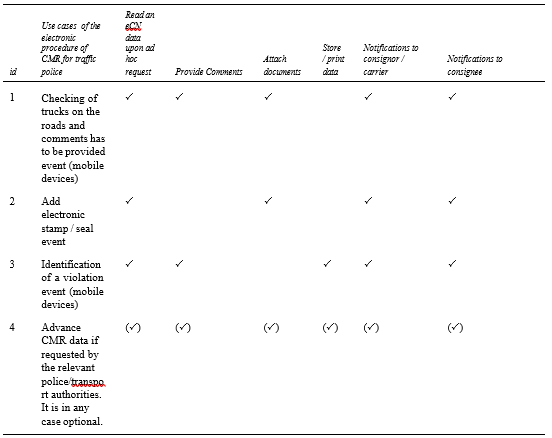
“successive carrier” means a third-party entity whose services the carrier makes use for the performance of the carriage for part or all of the carriage, and who is typically mentioned in, or covered by, the terms of the consignment note, paper or electronic, between the sender and carrier. That is, a single contract is performed by successive road carriers, each of them being responsible for the performance of the whole operation, and becoming a party to the contract of carriage by reason of their acceptance of the goods and the consignment note;
“subcontractor” means a third-party entity whose services the carrier makes use of for the performance of the carriage for part or all of the carriage, and who is typically not mentioned in, or covered by, the terms of the consignment note, paper or electronic, between the sender and carrier. That is, the contract between the carrier and subcontractor is governed by a separate contract which only covers that part of the carriage involving the subcontractor;
“Electronic Sub-consignment note” means the electronic consignment note that is being initiated, generated in final form and authenticated in the case where sub¬contractors are used. A sub electronic consignment note could be used between a carrier or freight forwarder and a sub-contractor or between a sub-contractor and another sub-contractor. The sub electronic consignment notes are always related to one master consignment note which declares who is the initial carrier for matters of liability; 
“User” means any entity which uses the consignment notes, paper or electronic, be it during the performance of the carriage or after the carriage has been completed. This includes the sender, carrier and consignee , but also successive carriers, subcontractors and freight forwarders;
“Public Authorities” means any entity from the public sector, indicatively mentioning courts, customs authorities, law enforcement entities etc, that are making use of the information being contained in the consignment notes, paper or electronic;
"Vehicles" means motor vehicles, articulated vehicles, trailers, and semi-trailers as defined in article 4 of the Convention on Road Traffic dated 19 September 1949.

IV. Users and roles

19. This section describes the different tasks, rights, and obligations of the different users of the system, their roles, and their data requirements.
20. The users of the eCMR system are divided into two categories:
  • (a) The eCMR “Users” are those defined in the Convention meaning Carrier, Consignor, Consignee. They have the right to create an electronic consignment note, change the data in the electronic consignment note based on the provisions of the CMR Convention as well as provide instructions, requests and comments at the different parts of the electronic consignment note again based on the provisions of the convention;
  • (b) The Public Authorities that have the right only to read the data of a specific electronic consignment note upon request while exercising their official duties in the context of customs and other formalities (such as roadside controls, control of cabotage, etc.). Beyond this access right foreseen in the CMR Convention, they may need to provide comments related to a specific Consignment Note, in order to fulfil other obligations stemming from their national legislation. These users indicatively could be the customs authorities, the police / frontiers guards, courts, and other entities1.

Footnote:1 The CMR Convention makes specific reference to customs / frontier traffic. For instance, article 1, paragraph 5 “The Contracting Parties agree not to vary any of the provisions of this Convention by special agreements between two or more of them, except to make it inapplicable to their frontier traffic…..”


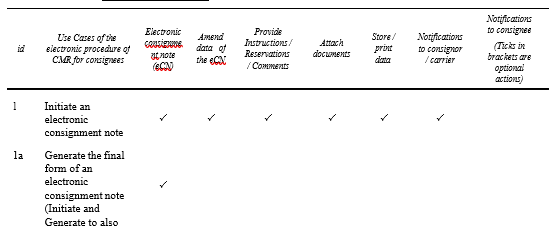
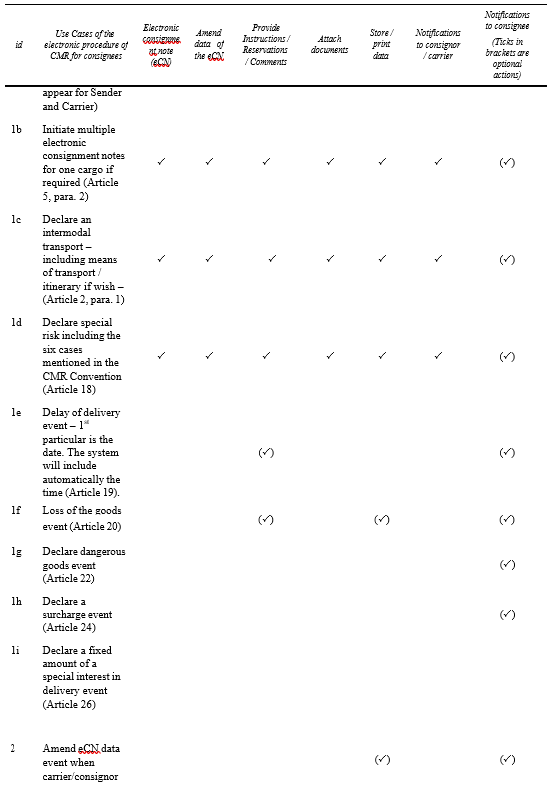
1. The eCMR Users of the electronic consignment note have the right to create and amend the data including provision of instructions, requests, comments, attaching of documents and storage of data
A. Consignor / Sender
21. The Consignor / Sender of the goods – is one of the users that can initiate an electronic consignment note. This gives the right to the consignors to have access to this eCMR’s data. This access should be guaranteed independently of the IT solutions used or technology, geographical region, and business culture / practices. Access should be also guaranteed to all services related to the handling and administering of the electronic consignment note.
22. Read – Write access to data based on the CMR Convention is being categorised as follows:
1. Access to initiate an electronic consignment note when the consignor is the one initiating the electronic consignment note:
  • (a) The initiator of the electronic consignment note has available several digital functionalities that ensure the application of the CMR Convention provisions: 
    • ​(i) To initiate several consignment notes if the goods have to be loaded in different vehicles or are of different kinds or are ​divided into different lots (Article 5, para. 2 of the convention);
    • (ii) To use the eighteen particulars listed in Article 6, paras. 1 and 2 of the CMR Convention as far as warranted and add in the electronic consignment note any other particulars which the issuer of the consignment note may deem useful (para. 3).
  • (b) To declare the special risks inherent in one or more of the following circumstances where the carrier could be relieved of liability (Article 17 and subject to Article 18, paras. 2–5)):
    • (i) Use of open unsheeted vehicles, (specification of the agreement to use unsheeted vehicles – art 17 para 4 (a) CMR Convention);
    • (ii) The lack of, or defective condition of packing, (para 4 (b) indication of this risk);
    • (iii) Handling, loading, stowage or unloading of the goods by the sender, the consignee or persons acting on behalf, (para 4 (c) indication of this risk);
    • (iv) The nature of certain kinds of goods, (para 4 (d) indication of this risk);
    • (v) Insufficiency or inadequacy of marks or numbers on the packages, (para 4 (e) indication of this risk);
    • (vi) The carriage of livestock. (para 4 (f) Indication of this risk).
  • (c) To perform intermodal transport and declare as such in the consignment note as long as the vehicle containing the goods is carried over part of the journey by sea, rail, inland waterways or air and the goods are not unloaded from the vehicle (Article 2, para. 1, CMR Convention);
  • (d) To declare the expected time/date of delivery. Article 19 defines the delay of delivery. The system should automatically generate to all parties involved, “a delay of delivery” notification when the expected date of delivery has been reached and a. no delivery processes as described below have been activated in the system b. no actions have been taken including provision of comments [ eCN change/update] for possible delay and change of date of delivery;
  • (e) To be notified for the loss of goods (Article 20, paras. 1–4):
    • (i) If the goods have not been delivered within thirty days following the expiry of the agreed time-limit – date of delivery – or if there were no agreed time limit, within sixty days from the time when the carrier took over the goods, the system should automatically declare the loss of goods and notify all parties;
    • (ii) Based on this notification the person entitled (the party that has the right of disposal of the goods at that point) could make a claim (implementation of Article 27, para. 1 / Article 32, para. 2). A “make a claim” digital functionality might exist;
    • (iii) In the course of the year following the payment of compensation if the goods are recovered, the carrier should notify the person entitled through the system. Again, such digital functionality might exist;
    • (iv) Within thirty days following the above-mentioned notification, the person entitled as aforesaid may require the goods to be delivered to him against payment of the charges. The person entitled should make this request in the system following the notification received;
    • (v) The Carrier shall be entitled to deal with the goods if none of the above-mentioned conditions are met.
  • (f) To declare the dangerous nature of the goods to the carrier (Article 22);
  • (g) To declare against payment of a surcharge to be agreed upon (Article 24), in the electronic consignment note a value for the goods exceeding the limit laid down in Article 23 / additional protocol to the convention;
  • (h) To declare in the electronic consignment note against a payment of a surcharge to be agreed upon, a fixed amount of a special interest in delivery in the case of loss or damage or of the agreed time-limit being exceeded (Article 26, para. 1).
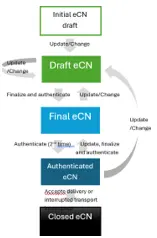
2. Access to generate the final form of the electronic consignment note:
The protocol stipulates the generation of the final form of the electronic consignment note, ready to be authenticated. The system should provide to the consignor the digital function of “generating the final form of the electronic consignment note”. The user that initiated the consignment note (Consignor/ Consignee/Carrier) should start the generation of the final form. When the final form has been authenticated by the two users then no more changes should be provided to the electronic consignment note. If a mistake is found for instance while visiting the customs or it was decided that more goods will be loaded etc therefore the electronic consignment note has to change after the generation and authentication of the final form, then the current one should be cancelled and a new one should be created and authenticated. Other missing information – not mistakes – unknown in the beginning of the travel, for instance the exact address of delivery, could be added later following the versioning mechanism of the eCNs.

3. Access to authenticate the final form of the electronic consignment note:
(a) The protocol stipulates the authentication of the final form of the electronic consignment note by the parties, meaning the carrier and the consignor. The system should provide the function to the consignor to “authenticate the final form of the electronic consignment note” sending in parallel an electronic copy to all parties (consignor, carrier, consignee) for their archives and safely saving the electronic copy in the archives of the system by registering it. This file with all the changes that will take place during the trip until the finalisation of the trip and the delivery of the goods listed in a chronological way, will be kept to the archives of the system / eCMR IT solution used to initiate the eCN for future access. 2

Footnote 2 Each eCN should be versioned (before and after finalization).

Only the latest authenticated version of an eCN should be considered legally valid.

Upon each eCN authentication, the authenticating user should be able to record a remark associated to the authentication.

Upon each new version of the eCN, the Consignor and the Carrier must be notified, and the Consignee may be notified (if he requested to). The only exception being for the author of the eCN change/new version (whether it’s the Consignor, Carrier or Consignee), that would not need to be notified.
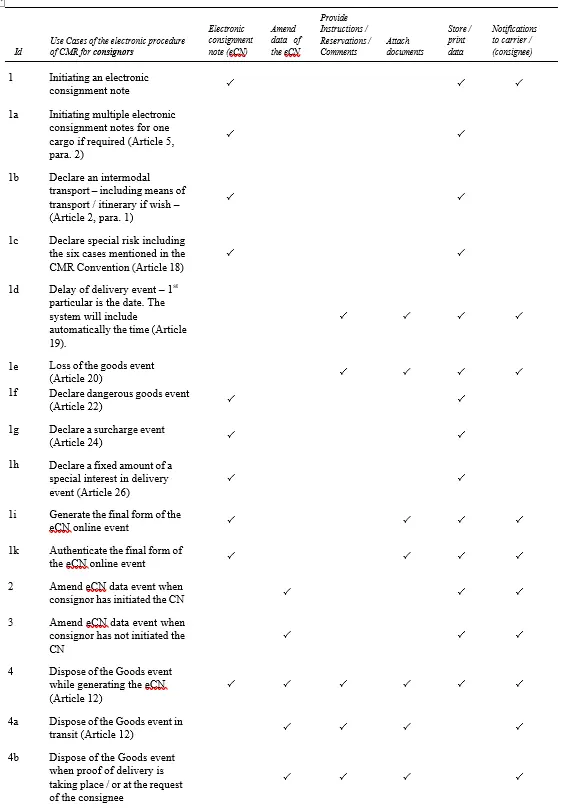
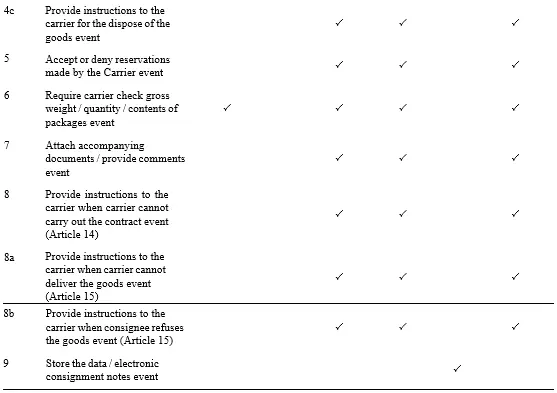
4. Access to amend the data when:
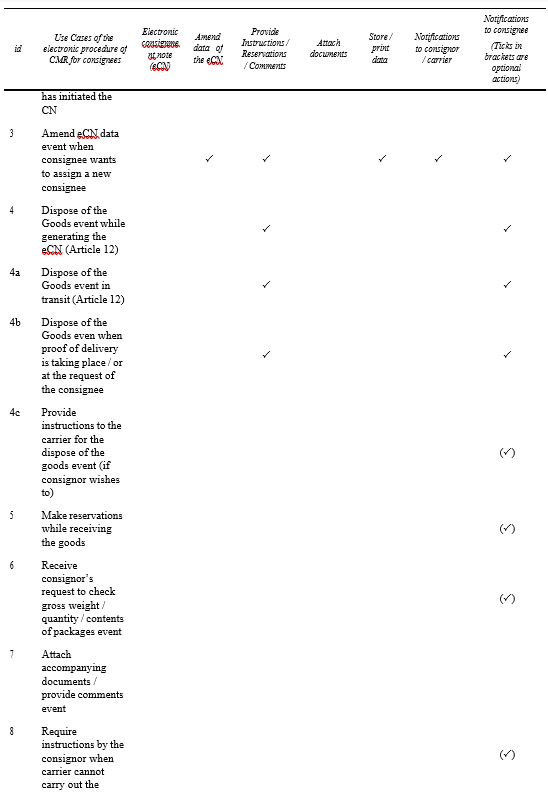
(a) The consignor has the right of disposal of the goods (Article 12, para. 1 CMR Convention). The consignor has the right to stop the goods in transit, to change the place of delivery or the consignee where the goods will be delivered. A notification should be sent to the carrier for these new instructions indicating that they are "new delivery instructions”. The consignor or whoever has the right of disposal of the goods and provides legally binding instructions – no comments – should authenticate themselves while providing those instructions;
(b) The consignor should have the ability to transfer (amend) the right of disposal of the goods to the consignee (Article 12, para. 2 CMR Convention) through the system since there is no paper copies anymore of the consignment note as the CMR Convention stipulates. A notification should be sent to the carrier and the consignee when the consignor “transfers” the consignor’s right to dispose of the goods indicating that the right of disposal of the goods was transferred. The consignor or whoever transfers the right of disposal of the goods - a legally binding action – should authenticate themselves while making this action;
(c) The consignor is the one that initiated the electronic consignment note but further changes are required in the particulars (Article 6 CMR Convention) before generating the final form of the electronic consignment note online, thereby accepting the sender’s liability (Article 7 CMR Convention);
(d) The consignor is not the one that initiated the electronic consignment note but changes are required in the particulars (Article 6 CMR Convention) provided by the carrier /consignee before generating the final form of the electronic consignment note online, thereby accepting like that sender’s liability (Article 7 CMR Convention).

5. Access to provide instructions / reservations / comments when:
(a) The sender shall require the carrier to check the gross weight of the goods / their quantity / contents of the packages. (Article 8, para. 3). The carrier might require charging for those checks and the consignor should be able to accept or not those extra charges. The system should be able to accommodate these functions;
(b) The sender attaches accompanying documents and requires providing comments on them by the carrier (Article 11 CMR Convention). The exact number and types of documents attached should be recorded in the system;3.
Footnote 3 The sender shall be liable to the carrier for any damage caused by the absence, inadequacy or irregularity of such documents and information, except in the case of some wrongful act or neglect on the part of the carrier.

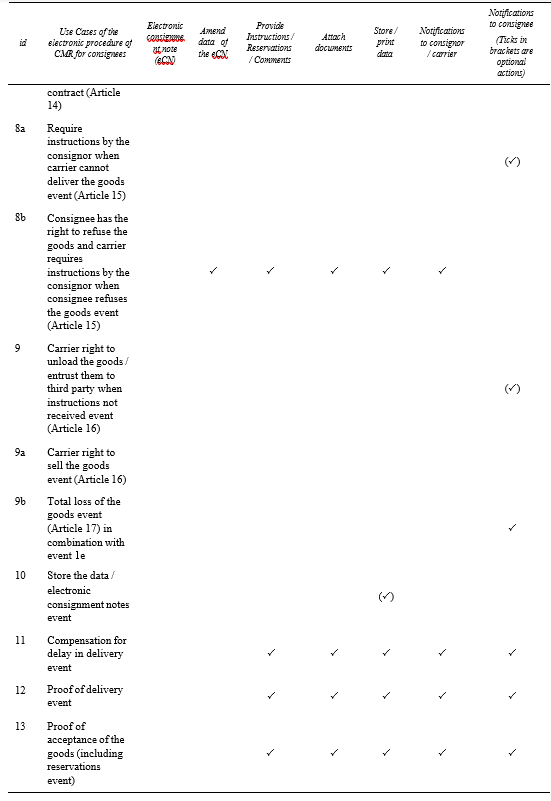
(c) The carrier cannot carry out the contract and did not receive new instructions in reasonable time, then carrier shall take such steps as seem to him to be in the best interests of the person entitled of disposal of the goods (Article 14, para. 2 CMR Convention). Asking for new instructions – within time limits if for instance perishable food is being transported - is a legally binding action and it should be registered accordingly. The consignor should receive however a notification from the carrier concerning those steps;
(d) The carrier provided reservations while taking over the goods either on the accuracy of the statements in the consignment note or the apparent condition of the goods and the sender should accept or deny those reservations (Article 8, para. 2 CMR Convention);
(e) The consignor has the right to dispose of the goods (Article 12, para. 1 CMR Convention). While amending the relevant data in the electronic consignment note, the consignor might be able to provide further comments / instructions to the carrier. A notification should be sent to the carrier for these new instructions;
(f) The consignor, if they wish, could make an entry while generating the electronic consignment note where the consignor transfers the right of disposal of the goods to the consignee from the moment the electronic consignment note is authenticated (Article 12, para. 3 CMR Convention). It should be noted that for the right of disposal the conditions of Article 12, para. 5 of the CMR Convention should apply;
(g) The carrier cannot carry out the contract and asks for instructions –instructions are requested (Article 14, para. 1 CMR Convention). Consignor should receive a notification with this new request;
(h) The carrier arrived at the place of delivery, but certain circumstances prevent delivery. The carrier should ask the sender for instructions (Article 15, para. 1 CMR Convention). The consignor should receive a notification and should be able to provide new instructions;
(i) If the consignee refuses the goods – notification should be sent to the consignor and the carrier, the consignor shall be entitled to dispose of them (Article 15, para. 1 CMR Convention)4.
Footnote 4 it may be recommended to have a «delivery» status in the eCN with for example the following statuses:
-In preparation (until the eCN is authenticated).
- Scheduled (when the eCN is authenticated and until the transport starts)< Delivered (upon delivery and until acceptance)
-Accepted (when accepted by Consignee)
-Refused (when refused by Consignee)
- Cancelled (in special cases).
Upon a change of this eCN content value (automatically done upon performing the «delivery process», the Consignor, Carrier and Consignee get automatically notified.

6. Access to attach accompanying documents when:
(a) It should be foreseen that the future eCMR applications should provide the possibility to at least attach the accompanying documents to the electronic consignment note documents as pdf, Jpeg or any other format convenient at the time. If the possibility to interconnect with other systems that generate accompanying documents exists, then such interconnection should be allowed, and the data of those documents could be also sent through electronic messages;
(b) For customs or other formalities, the sender shall attach the necessary documents to the electronic consignment note (Article 11 CMR Convention).
7. Access to store the data of the electronic consignments generated where the sender is specifically mentioned as “consignor” (Article 5 CMR Convention)


B. Carrier [ Transport Company / Successive Carriers / Freight Forwarders Sub Contractors /]
23. The CMR Convention refers only to carriers and to successive carriers. The eCMR protocol though mentions that an “Electronic consignment note” means a consignment note issued by electronic communication by the carrier, the sender or any other party interested in the performance of a contract of carriage to which the Convention applies. It is understandable though that the user of the future eCMR system recognized as carrier could be anyone that coordinates and delivers road transport services therefore uses the CMR Convention today.
24. In that sense the freight forwarders and the sub-contractors could have the role of the carrier in the future eCMR system defining though always their identity which might implies different liability processes, especially following national laws.
25 The different roles also that subcontractors play in modern Logistics / intermodal transport should be observed. In some cases, subcontractors can be a sender and in some other cases a consignee or a carrier.
26. It should be mentioned that not all countries accept / follow these practices and that in some countries national legislations clearly distinguish the roles and therefore the liabilities of a carrier / transporter and of a freight forwarder / sub-contractor. The future eCMR system should be able to provide the electronic services that accommodate those practices leaving it to the users to decide whether is appropriate/ required to be used.

Carrier
27. The carrier is one of the users responsible for initiating an eCMR consignment note. This gives the right to the carrier to have access to eCMRs data. This access should be guaranteed independently of the IT solutions used or technology, geographical region and business culture / practices. Access should be also guaranteed to all services related to the handling and administering of the electronic consignment note.
28. Read -Write access to data based on the CMR Convention is being categorised as follows.
1. Access to initiate a consignment note when the carrier is the one initiating the electronic consignment note:
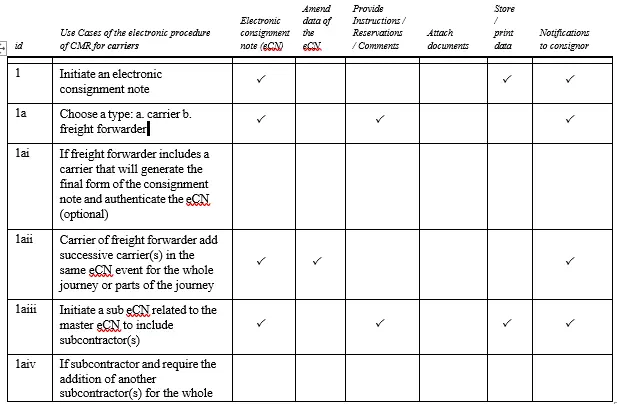
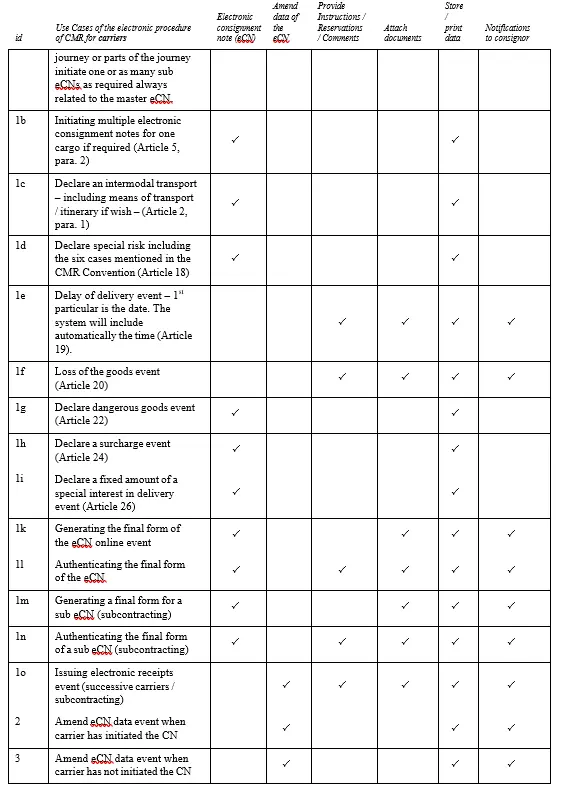
(a) To initiate several consignment notes if the goods have to be loaded in different vehicles or are of different kinds or are divided into different lots (Article 5, para. 2 of the convention);
(b) To use the eighteen particulars listed in Article 6, paras. 1 and 2 of the CMR Convention and add in the electronic consignment note any other particulars which  the  issuer  of  the  consignment  note  may  deem  useful (para. 3);
(c) To declare the special risks inherent in one or more of the following circumstances where the carrier could be relieved of liability (Article 17 and subject to Article 18, paras. 2–5)):
​​(i) Use of open unsheeted vehicles, (specification of the agreement to use unsheeted vehicles – art 17 para 4 (a) CMR Convention);
​(ii) The lack of, or defective condition of packing, (indication of this risk);
​(iii) Handling, loading, stowage or unloading of the goods by the sender, the consignee or persons acting on behalf, (indication of this risk);
​(iv) The nature of certain kinds of goods, (indication of this risk);
​(v) Insufficiency or inadequacy of marks or numbers on the packages, (indication of this risk);
​(vi).  The carriage of livestock (indication of this risk).
(d) To perform intermodal transport and declare as such in the consignment note as long as the vehicle containing the goods is carried over part of the journey by sea, rail, inland waterways or air and the goods are not unloaded from the vehicle (Article 2, para. 1, CMR Convention);
(e) To declare the expected time/date of delivery. Article 19 defines the delay of delivery. The system should automatically generate a notification to all parties involved “a delay of delivery” notification when the expected date of delivery has been reached and a. no delivery processes as described below have been activated in the system b. no actions have been taken including provision of comments for possible delay and change of date of delivery;
(f) To notify for the loss of goods (Article 20, paras. 1–4):
​(i) Based on the convention, If the goods have not been delivered within thirty days following the expiry of the agreed time-limit – date of delivery – or if there were no agreed time limit, within sixty days from the time when the carrier took over the goods, the system should automatically declare the loss of goods and notify all parties. However, the carrier should be able through the system to inform the consignor and the consignee during the different stages of delivery;
​(ii) Based on this notification the person entitled could make a claim (implementation of Article 27, para. 1 / Article 32, para. 2). A “make a claim” digital function might exist;
​(iii) In the course of the year following the payment of compensation if the goods are recovered, the carrier should notify the person entitled through the system. Again, such digital function might exist;
​(iv) Within thirty days following the above-mentioned notification, the person entitled as aforesaid may require the goods to be delivered to him against payment of the charges. The person entitled should make this request in the system following the notification received;
(v) The carrier shall be entitled to deal with the goods if none of the above-mentioned conditions are met.

2. Access to generate the final form of the electronic consignment note:
(a) The eCMR additional protocol stipulates the generation of the final form of the electronic consignment note, ready to be authenticated. The system should provide to the carrier this function of “generating the final form of the electronic consignment note”. The user that initiated the consignment note (Consignor/ Consignee/Carrier) should start the generation of the final form. When the final form has been authenticated by the two users then no more changes should be provided to the electronic consignment note. If a mistake is found for instance while visiting the customs or it was decided that more goods will be loaded etc therefore the electronic consignment note has to change after the generation and authentication of the final form, then the current one should be cancelled and a new one should be created and authenticated.

3. Access to authenticate the final form of the electronic consignment note:
(a) The eCMR additional protocol stipulates the authentication of the final form of the electronic consignment note by the parties, meaning the carrier and the consignor. The system should provide the function to the carrier to “authenticate the final form of the electronic consignment note” sending in parallel an electronic copy to all parties (consignor, carrier, consignee) for their archives and safely saving the electronic copy in the archives of the system by registering it. This file with all the changes that will take place during the trip until the finalisation of the trip and the delivery of the goods listed in a chronological way (versioning of eCNs as mentioned earlier) will be kept to the archives of the system for future access.

4. Access to amend the data when:
(a) The carrier is the one that initiated the electronic consignment note but further changes are required in the particulars (Article 6 CMR Convention) before generating the final form of the electronic consignment note online, thereby accepting the carrier’s liability (Article 17 CMR Convention);
(b) The carrier is not the one that initiated the electronic consignment note but changes are required in the particulars (Article 6 CMR Convention) provided by the consignor / consignee before generating the final form of the electronic consignment note online, thereby accepting like that sender’s liability (Article 17 CMR Convention);
(c) The consignor has the right to dispose of the goods (Article 12, para. 1 CMR Convention). The consignor has the right to stop the goods in transit, to change the place of delivery or the consignee where the goods will be delivered. A notification should be sent to the Carrier for these new instructions indicating that they are "new delivery instructions”. The carrier should acknowledge receipt of those new delivery instructions through the system.
(d) The consignor should have the ability to transfer (amend) the right to dispose of the goods to the consignee (Article 12, para. 2 CMR Convention) since there is no second copy of the consignment note as the CMR Convention stipulates. A notification should be sent to the Carrier and the Consignee when the consignor “transfers” the consignor’s right to dispose of the goods indicating that it is about the transfer of right to dispose of the goods. The carrier should acknowledge receipt of those new delivery instructions through the system.
5. Access to provide instructions / reservations / comments when:
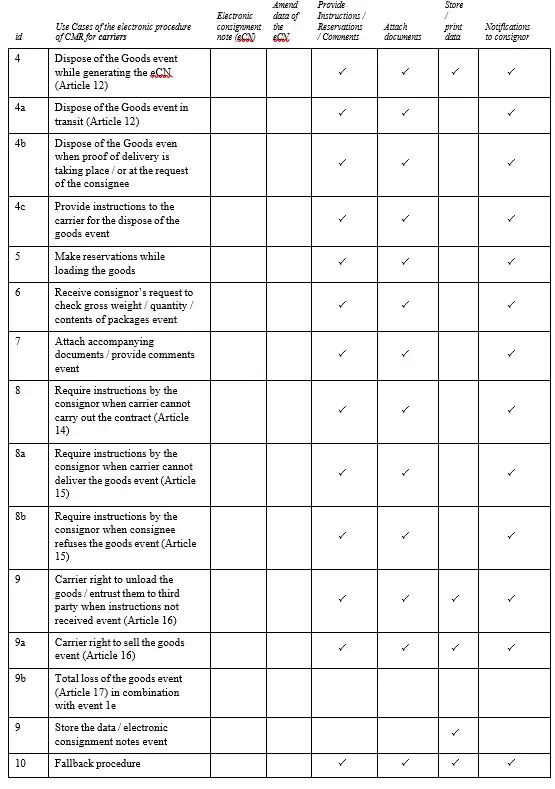
(a) The sender shall require the carrier to check the gross weight of the goods / their quantity / contents of the packages (Article 8, para. 3 CMR Convention). The carrier has the right though to charge for those checks and insert the results in the electronic consignment note. Both functions should be accommodated by the eCMR system;
(b) The sender attaches accompanying documents and requires providing comments on them (Article 11 CMR Convention). The Carrier should have the right to provide comments, remarks, or provide attachments concerning those accompanying documents. A notification should be sent to the sender when Carrier is providing comments (Article 11, para. 2, CMR Convention). The exact number and types of documents attached should be recorded in the system;
(c) If the carrier cannot carry out the contract and did not receive new instructions in reasonable time, then carrier shall take such steps as seem to him to be in the best interests of the person entitled to dispose of the goods (Article 14, para. 2 CMR Convention). The consignor should receive however a notification from the carrier concerning those steps;
(d) The carrier provided reservations while taking over the goods either on the accuracy of the statements in the consignment note or the apparent condition of the goods and the sender should accept or deny those reservations (Article 8, para. 2 CMR Convention). The carrier should be able to upload pictures or videos related to those reservations which specify the ground for those reservations;
(e) The consignor has the right to dispose of the goods (Article 12, para. 1 CMR Convention). While amending the relevant data in the electronic consignment note the consignor might be able to provide further comments / instructions to the carrier. A notification should be sent to the carrier for these new instructions. The carrier should acknowledge receipt of those new instructions – connected with carrier’s liability – and should be able to ask clarifications on these instructions;
(f) The consignor, if they wish, could make an entry while generating the electronic consignment note where the consignor transfers the right of disposal of the goods to the consignee from the moment the electronic consignment note is authenticated (Article 12, para. 3 CMR Convention);
(g) The right of disposal of the goods is critical for the well-functioning of the convention. It should always be clear to the carrier who at certain point while in transit has the right of disposal of the goods and from whom therefore should receive instructions. A specific function should exist in the system “right of disposal of the goods” that clearly indicates which user has this right. When any of the cases below applies, then automatically by the system the right will be transferred to the other user (Article 12, para. 5 CMR Convention);
(h) If the carrier cannot carry out the contract and asks for instructions (Article 14, para. 1 CMR Convention), the consignor should receive a notification. Both the carrier and the consignor should be able to interact on this issue electronically;
(i) If the carrier cannot carry out the contract and has not received new instructions within a reasonable time, the carrier shall take such steps as seem to him to be in the best interests of the person entitled to dispose of the goods (Article 14, para. 2 CMR Convention). However, the consignor should receive a notification from the carrier concerning those steps;
(j) If the carrier arrives at the place of delivery, but certain circumstances prevent delivery, the carrier should ask the sender for instructions (Article 15, para. 1 CMR Convention). The consignor should receive a notification and should be able to provide new instructions;
(k) If the consignee refuses the goods, notification should be sent to the consignor and the carrier, the consignor shall be entitled to dispose of them (Article 15, para. 1 CMR Convention);
(l) Following the above mentioned, the carrier (Article 16, para. 2, CMR Convention) has the right to unload the goods, hold the goods or entrust them to a third party. In all cases the carrier should send a notification through the system to the sender notifying about the carrier’s decision;
(m) The carrier may sell the goods (perishable goods, storage expenses, expiry of a reasonable period, Article 16, para. 3 CMR Convention), In all cases the carrier should send a notification through the system to the sender notifying about carrier’s decision;
(n) The carrier shall be liable for the total or partial loss of the goods and for damage (Article 17, para. 1 CMR Convention), in these cases a notification should be sent by the carrier to the consignor/ consignee explaining what happened.

6. Access to attach accompanying documents when:
For customs or other formalities, the sender shall attach the necessary documents to the electronic consignment note (Article 11 CMR Convention). The carrier should be able to check these documents and inform the sender in case there is something missing / wrongly provided etc. This step relates to extra charges that might occur and time in case the documents provided are not efficient or provide correct data. Therefore, the carrier will be able to be covered vis a vis these extra charges.

7. Access to store the data of the electronic consignments generated where the carrier is specifically mentioned as “consignor” (Article 5 CMR Convention):

Successive Carriers
29. The carrier should be able to add in the electronic consignment note its successive carriers. The carrier should be able to do this at any point. The carrier should be able to add as many successive carriers as requires. Also, the carrier should be able to define which part of the journey will be covered by which successive carrier. For reasons of liability the successive carriers should through the system be able to confirm that they are responsible for the specific parts of the journey and provide comments, reservations and amendments to the data of the electronic consignment note accordingly. Based on the convention (article 35) the successive carriers shall enter on the second copy of the consignment note their name and address as well as any reservations.
30. Based on the CMR Convention (Article 34), the second carrier and each succeeding carrier may become a party to the contract of carriage, under the terms of the consignment note, by reason of carrier’s acceptance of the goods and the original consignment note. Therefore, the successive carriers should follow the same rules and conditions as the carriers concerning authentication and electronic recognition (for instance electronic signatures). The successive carriers should be able through the system:
(a) To have the same amending rights as the Carrier to the electronic consignment note for the period they are taking over of the transportation of the goods; and
(b) To have the same rights to provide comments as the Carrier to the electronic consignment note for the period, they are taking over transportation of the goods.

31. Based on article 35 of the convention a carrier accepting the goods from a previous carrier shall give the latter a dated and signed receipt. Where applicable, the carrier should be able to enter on the receipt reservations of the kind provided for in article 8 paragraph 2 of the convention. The eCMR system should be able to accommodate this provision by providing electronic receipts. This electronic receipt should be authenticated by both carriers following the authentication methods described for the electronic consignment note. The successive carrier after physically checking the goods, their status etc should be able to include in the electronic receipt comments, upload photos, links to videos etc.

Freight forwarders
32. If a freight forwarder negotiates and later signs a contract of carriage at his costs and name, including an "all in" service charge, they should be regarded as a contractual service provider (a "carrier") with all of the implications resulting from the CMR or any other conventions related to the respective mode of transport provided that the freight forwarder was duly entitled by the sender and this is expressly included in the contract entered between both sender and freight forwarder.
33. In that case, that forwarder (and any other transport provider as well) shall be allowed to subcontract the scope of his contract to other parties without any consent needed from the opposite party to the original contract of carriage. If such a scheme happens the freight forwarder (or any other transport provider) remains liable as if it performs the contract by itself. The "performing transport provider" will then also be liable for any damage or delay but to its principal freight forwarder (or any other transport provider). The performing provider is entitled to same rights but also obligations mentioned in the CMR Convention.
34. The contractual freight forwarder may convey any extraordinary conditions mentioned in the original contract of carriage to its subcontractor only subject to subcontractors' explicit acceptance. In case of dispute the freight forwarder and its subcontractors are liable for a loss or damage jointly and equally. It should be noted that this regime / practice is not being accepted by all countries. Some national legislations clearly distinguish the roles and liabilities of a carrier and a freight forwarder, and they do not accept a freight forwarder to act as a carrier.
35. In the position of a service provider the freight forwarder issues or signs a CMR to the client in his title. Towards the subcontractor a transport order or any other written proof of a subcontract should be sufficient (here we are quite short in providing the legal and complete proof of dispatch = the performing transport provider can and may not sign the "original" CMR "on behalf of" his principal freight forwarder, and a dispatch note - of whatever kind - is not accepted as a legal document in case of a damage or loss claim). In any case an option of a CMR has been declined in this respect. The reason results again from the differences between existing national legislation.

Sub-Contractors
36. Subcontracted carriers are not parties to the same contract. There are consequently several contracts:
(a) a consignment note between the principal and the contracted carrier and;
(b) a contract of sub carriage between the contracted carrier and the sub-contracted carrier.
37. Possibly, a new consignment note must be drawn up for each sub-contracted carrier, in which the subcontracting carrier is entered as the sender. The sub-contracted carrier is liable only to the initial carrier, whilst the latter is liable to the sender and the consignee for acts and omissions on the part of other parties, he may use for the transport operation (including the sub-contracted carriers).

What is the difference between a successive carrier and a sub-contracted carrier?
38. At first glance, the role of a successive carrier and a sub-contracted carrier is similar: each executes a part of the road transport. It should be noted that the Dutch Supreme Court recently ruled that the necessary conditions for being considered a successive carrier under Article 34 of the CMR Convention are also met in the case where the main carrier (and other carriers) are uniquely contracted carriers and have not in fact completed a portion of transport themselves.
39. The difference thus lies in the responsibility of each towards its partners: ꞏ Successive carriers are parties to the same and unique contract of carriage. Each carrier is totally liable to the sender and to the consignee for the execution of the transport operation. The carriage is undertaken with only one CMR consignment note, which covers the entirety of the transport, in which the successive carriers enter their names and addresses (cf. also question 11). Sub-contracted carriers are not parties to the same contract of carriage. There are consequently several contracts: a contract of carriage between the principal and the contracted carrier and a contract of subcarriage between the contracted carrier and the sub¬contracted carrier. A new consignment note must be drawn up for each sub-contracted carrier, where the subcontracting carrier is entered as the sender. The sub-contracted carrier is liable only to the initial carrier, whilst the latter is liable to the sender and the consignee for acts and omissions on the part of other parties, he may use for the transport operation (including the sub-contracted carriers).”
40. From discussions, in practice, the freight forwarder receives the booking from a client and then gives an order to a haulier. This haulier could also pass the booking on to another haulier, and this is not unusual. All would be deemed to be carrier or successive carrier and therefore all parties would bear liability towards the consignee. In practice no one fills in the successive carrier box and only the actual transport company stamps and signs the CMR.
41. This is an example of sub-contractor that would be used on a regular basis. A company receives an order from a company to transport goods from Spain to Kazakhstan. Then the company should prepare two separate CMRs usually (1) from collection point in Spain up to a transit depot in the Baltics (2) from collection point in the Baltics to the destination in Kazakhstan. For each separate CMR we would have a different contract with a completely different haulier, each only responsible for their own CMR transaction. Neither would be a party to the contract for the complete journey, so one would think in this case subcontractors should be considered (i.e. there would be two CMRs for the same shipment).
42. At the end of the day the freight forwarder has a responsibility either as the carrier or appointing the correct haulier.
43. Therefore, the eCMR system should be able to:
(a) While initiating an electronic consignment note to give the option for the user to identify itself as a. carrier, or b. freight forwarder, and to each of them to have the possibility to introduce successive carriers;
(b) The freight forwarder should have the option to either generate and authenticate the final form of the electronic consignment note by him/herself or only to initiate the electronic consignment note and declare a carrier that should generate and authenticate the final form of the electronic consignment note;
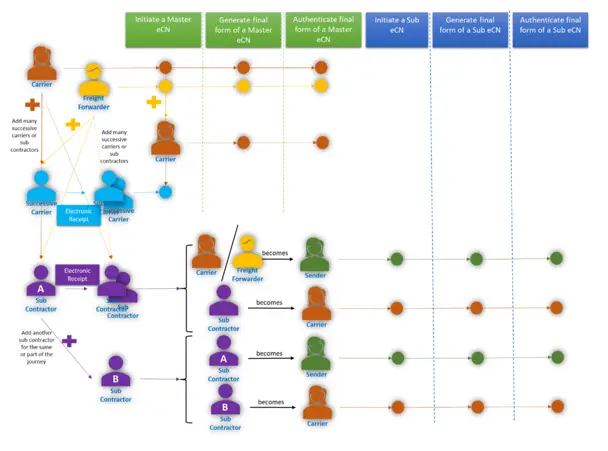
(c) The carrier and a freight forwarder that acts as a carrier should have the possibility to declare sub-contractors for part or for the whole journey. In this case, a new electronic consignment note could be initiated with the following specifications:
​(i) This new electronic consignment note should be “connected” with the initial consignment note maybe declared a “sub electronic consignment note”. Like that the system and its users will always know that it is related to another “master” electronic consignment note;
​(ii) In this sub-electronic consignment note the sender will be the initial carrier and the carrier will be the sub-contractor;
​(iii) The sub-contractor will then have all handling and administrative electronic services for this electronic consignment note as the carrier has for the master electronic consignment note;
​(iv) For this sub-electronic consignment note a final form should be generated and authenticated by the carrier and the sub-contractor;
​(v) If the carrier uses different sub-contractors for different parts of the same journey, then the carrier should initiate as many sub-electronic consignment note as the sub-contractors are;
​(vi) In this case, at each taking over of the goods an electronic receipt will be generated – like that used by the successive carriers – dated and authenticated giving the opportunity to the sub-contractors to provide comments and reservations with the possibility to accept or deny them;
​(vii) Also, any subcontractor could then have another subcontractor for the trip that was initially subcontracted. In that case the subcontractor should act now as the sender and the new subcontractor as the carrier. All other services will follow the same as was the case for the consignor / sender and the carrier.
44. The following schema summarizes all these cases.


C. Consignee / Receiver
45. The consignee as receiver of the goods, based on the CMR Convention has certain rights and obligations. The consignee should be notified (email address / mobile phone) that they have been designated as the consignee/receiver at the time an eCMR consignment note is being authenticated.
46. The Consignees should have access to the data independently of the IT solution (meaning independently of technology, geography, business culture, etc.).
1. Read -Write access to initiate an electronic consignment note when the consignee is the one initiating the electronic consignment note:
(a) To initiate several consignment notes if the goods have to be loaded in different vehicles or are of different kinds or are divided into different lots (Article 5, para. 2 of the convention);
(b) To use the eighteen particulars listed in Article 6, paras. 1 and 2 of the CMR Convention as far as warranted and add in the electronic consignment note any other particulars which the issuer of the consignment note may deem useful (para. 3);
(c) To declare the special risks inherent in one or more of the following circumstances where the carrier could be relieved of liability (Article 17 and subject to Article 18, paras. 2–5)):
​(i) Use of open unsheeted vehicles, (specification of the agreement to use unsheeted vehicles – art 17 para 4 (a) CMR Convention);
​(ii) The lack of, or defective condition of packing, (indication of this risk);
​(iii) Handling, loading, stowage or unloading of the goods by the sender, the consignee or persons acting on behalf, (indication of this risk);
​(iv) The nature of certain kinds of goods, (indication of this risk);
​(v) Insufficiency or inadequacy of marks or numbers on the packages, (indication of this risk);
​(vi) The carriage of livestock (indication of this risk);
(d) To perform intermodal transport and declare as such in the consignment note as long as the vehicle containing the goods is carried over part of the journey by sea, rail, inland waterways or air and the goods are not unloaded from the vehicle (Article 2, para. 1, CMR Convention);
(e) To declare the expected time/date of delivery. Article 19 defines the delay of delivery. The system should automatically generate a notification to all parties involved “a delay of delivery” notification when the expected date of delivery has been reached and a. no delivery processes as described below have been activated in the system b. no actions have been taken including provision of comments for possible delay and change of date of delivery;
(f) To be notified for the loss of goods (Article 20, paras. 1–4);
​(i) If the goods have not been delivered within thirty days following the expiry of the agreed time-limit – date of delivery – or if there were no agreed time limit, within sixty days from the time when the carrier took over the goods, the system should automatically declare the loss of goods and notify all parties;
​(ii) Based on this notification the person entitled could make a claim (implementation of Article 27, para. 1 / Article 32, para. 2). A “make a claim” electronic service should exist;
​(iii) In the course of the year following the payment of compensation if the goods are recovered, the carrier should notify the person entitled through the system. Again, such electronic service should exist; 
​(iv) Within thirty days following the above-mentioned notification, the person entitled as aforesaid may require the goods to be delivered to him against payment of the charges. The person entitled should make this request in the system following the notification received;
​(v) The Carrier shall be entitled to deal with the goods if none of the above¬mentioned conditions are met.
(g) To declare the dangerous nature of the goods to the carrier (Article 22);
(h) To declare against payment of a surcharge to be agreed upon (Article 24), in the electronic consignment note a value for the goods exceeding the limit laid down in Article 23 / additional protocol to the convention.
(i) To declare in the electronic consignment note against a payment of a surcharge to be agreed upon, a fixed amount of a special interest in delivery in the case of loss or damage or   of   the   agreed   time-limit   being   exceeded   (Article   26, para. 1).

2. Access to read an electronic consignment note: when the carrier/consignor have initiated one declaring the specific consignee and only if the carrier / consignor agrees the consignee to have read access to the electronic consignment note

3. Access to amend the data when:
(a) The consignee has the right of disposal of the goods (Article 12, para. 3 CMR Convention) and wants to provide an order for the goods to be delivered to another person if the sender makes an entry to that effect in the electronic consignment note. Then the consignee becomes the sender, and the other person becomes the consignee5. The consignee should be able to declare a new consignee in the system. The right of disposal will apply as the cases being described for the consignor / consignee. When the right of disposal of the goods is transferred the Consignee could decide if the Consignor will still receive notifications for any changes in the electronic consignment note – continuation for instance of the trip – or not.
Footnote 5 Article 12 / 4. If in exercising his right of disposal the consignee has ordered the delivery of the goods to another person, that other person shall not be entitled to name other consignees. 5. The exercise of the right of disposal shall be subject to the following conditions:(a) That the sender or, in the case referred to in paragraph 3 of this article, the consignee who wishes to exercise the right produces the first copy of the consignment note on which the new instructions to the carrier have been entered and indemnifies the carrier against all expenses, loss and damage involved in carrying out such instructions ; (b) That the carrying out of such instructions is possible at the 'time when the instructions reach the person who is to carry them out and does not either interfere with the normal working of the carrier's undertaking or prejudice the senders or consignees of other consignments;(с) That the instructions do not result in a division of the consignment. 6. When, by reason of the provisions of paragraph 5 (b) of this article, the carrier cannot carry out the instructions which he receives, he shall immediately notify the person who gave him such instructions (missing to be added). 7. A carrier who has not carried out the instructions given under the conditions provided for in this article, or who has carried them out without requiring the first copy of the consignment note to be produced, shall be liable to the person entitled to make a claim for any loss or damage caused thereby.

4. Access to provide comments when:
(a) The consignor, if they wish, could make an entry while generating the electronic consignment note where the consignor transfers the right of disposal of the goods to the consignee from the moment the electronic consignment note is generated (Article 12, para. 3 CMR Convention), it should be noted that for the right of disposal the conditions of Article 12, para. 5 of the CMR Convention should apply, the consignee should receive a notification and be able to provide comments if needed or amend the data (new consignee) as provided above;
(b) the consignee has the right to refuse the goods and provide therefore reservations accordingly if access to read the data of the electronic consignment note has been provided – notification should be sent to the consignor and the Carrier, the consignor shall be entitled to dispose of them (Article 15, para. 1 CMR Convention);
(c) Even if the consignee has refused the goods, the consignee may nevertheless require delivery as long as the carrier has not received instructions to the contrary from the sender (Article 15, para. 2 CMR). The future system should accommodate such an event;
(d) the consignee takes delivery of the goods (Article 30, paras. 1–5). If written reservations are not made by the consignee in the case of apparent loss or damage and within seven days of delivery, with the exception of Sundays and public holidays in the case of loss or damage which is not apparent, the fact that delivery has taken place shall be prima facie evidence that consignee received the goods in the condition described in the consignment note. The platform should provide the 7 days ability of notification from the consignee to the carrier in the form of reservations;
(e) The consignee, in order to receive a compensation for delay in delivery has to make a written reservation to the carrier through the system within 21 days from the time the goods were placed at the disposal of the consignee. The platform should provide this 21 days service to declare a compensation for delay in delivery to the consignee with relevant notification to the carrier;
(f) The CMR Convention and the eCMR Additional Protocol do not foresee the existence of a proof of delivery for the consignees. However, with the assistance of the technology a function could be developed that includes two steps: a. the proof of delivery and b. the proof of acceptance:
​(i) Proof of delivery: technology could assist and provide a twofold verification of the already authenticated consignee. For instance, at the time the consignment note is concluded online, the consignee receives in their mobile phone / email address a unique code. This code will be asked by the carrier during the delivery of goods to the consignee to be inserted in the system in order to receive delivery of the goods. This will be also the time where the consignee gets the right of disposal of the goods, thereby replacing the receipt of the second copy of the consignment note. This action would trigger notifications to the relevant users that the goods have arrived at their destination;
​(ii)   Proof of acceptance or not of the goods: the next step should be the proof of acceptance of delivery. The consignee based on the CMR Convention has the right to check the goods and accept them or not – with relevant consequences – or even to declare a new consignee. Therefore, the consignee should enter in the system and either accept the delivery online finalizing the delivery being described in the consignment note or making reservations / remarks / comments (uploading attachments). The carrier in that moment will have the opportunity to read those comments without being able to change / delete them but be able to provide replies if needed.

5. Access to attach accompanying documents when:
(a) Reservations are made during delivery and consignee needs to upload photos, videos and extra documentation to prove those reservations.

6. Access to store the data:


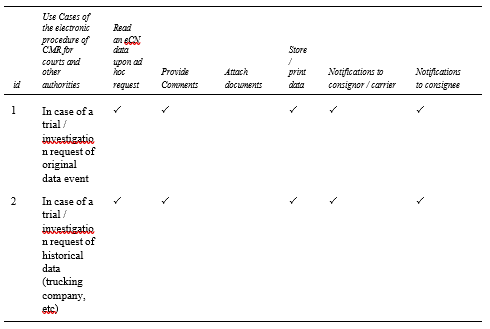
2. Public Authorities users of the electronic consignment having the right to read the data of electronic consignment note upon request, and, if required by law, provide comments and store the data
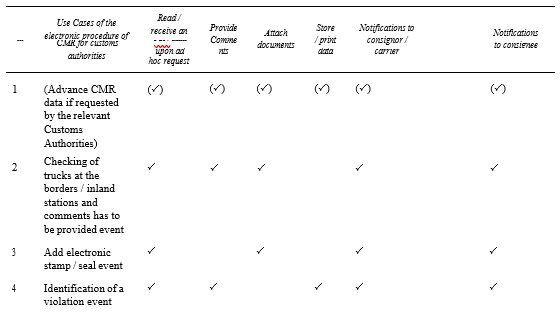
47. The Public Authorities have the right only to read the data upon request of a specific electronic consignment note while exercising their official duties. Beyond this access right, they may need to provide comments related to a specific consignment note , in order to fulfil other obligations stemming from their national legislation. These users are the public authorities specifically the customs authorities, the police / frontiers guards, courts and other relevant entities.

A. Customs Authorities
48. Customs Authorities are recognized as one of the users of the future eCMR system. Customs authorities for reasons that are different in several geographical regions are using / checking the CMR consignment notes. The CMR Convention specifically refers to customs authorities / frontier traffic in different parts of the legal text:
(a) Article 1, paragraph 5 “The Contracting Parties agree not to vary any of the provisions of this Convention by special agreements between two or more of them, except to make it inapplicable to their frontier traffic…”,
(b) Article 6, paragraph 1 “The consignment note shall contain the following particulars: (j) The requisite instructions for Customs and other formalities;”
(c) Article 7, paragraph 1 “The sender shall be responsible for all expenses, loss and damage sustained by the carrier by reason of the inaccuracy or inadequacy of: (a) The particulars specified in article 6, paragraph 1(b), (c), (d), (f), (g), (h) and (j);”
(d) Article 11, paragraph 1 and 2“For the purposes of the Customs or other formalities which have to be completed before delivery of the goods, the sender shall attach the necessary documents to the consignment note or place them at the disposal of the carrier and shall furnish him with all the information which he requires. The carrier shall not be under any duty to enquire into either the accuracy or the adequacy of such documents and information. The sender shall be liable to the carrier for any damage caused Ъ$ the absence, inadequacy or irregularity of such documents and information, except in the case of some wrongful act or neglect on the part of the carrier.”
49. It has to be noted that among others the comments of customs are also connected with issues relevant to liability of the carriers (Article 17, para. 4 CMR Convention) such as lack of or defective condition of packing in the case of goods which by their nature are liable to wastage or to be damaged when not packed, the nature of certain kinds of goods which particularly exposes them to total or partial loss or to damage, especially through breakage, rust, decay, desiccation, leakage, normal wastage or the action of moth or vermin etc. In that sense, it is up to the contractual parties (i.e. consignor, carrier, consignee) to provide comments whenever they observe anything about the truck or the cargo or any other operational issue.
50. The customs authorities should have “on demand reading access” to the data of electronic consignment note meaning that when a truck arrives at their borders or customs offices, the customs officer should be able to “read the data” if required. Beyond this access right, customs authorities may need to “provide comments” related to a specific consignment note, in order to fulfil other obligations stemming from their national legislation. This comment should be accessible only by customs independently of the IT solution (meaning independently of technology, geography, business culture etc.). The comments cannot be edited or deleted. The comments should be readable by all parties involved including officers from other Customs Authorities (listed on chronological order).
51. However, in case of violation the customs authorities should have the right to request storage of the data and therefore they should have the ability to retain the data of a specific electronic consignment note. 
52. In addition, Customs authorities should have the possibility to add an electronic stamp or seal. Specifications should correspond to the needs of public authorities and their rights to demand data.
53. Finally, some customs authorities would consider it great value to receive “advance eCMR data” meaning to receive this information well before the trucks arrives at their borders for example at the moment an electronic consignment note is generated and finalised online. Such a proposal has several benefits and challenges to be addressed.
54. Potential benefits could include:
(a) Customs authorities receiving this data being able to perform a risk analysis of the truck and the goods it is carrying well before the truck arrives at their borders. This would result in better operations of green lanes, less queues at the borders, higher efficiency of borders operations;
(b) For the trucking industry this would mean reduced waiting times at the borders, better management of the trip and therefore higher customer service and better delivery times.
55. As challenges could be identified:
(a) The IT solutions that generate the electronic consignment notes should provide the ability to the users to define the exact itinerary that will be followed by the Carrier knowing that for several reasons this itinerary might change en route and the driver may have to amend this specific data. This service, if provided, should not be included in the process of making the electronic consignment note but rather linked to a specific electronic consignment note;
(b) In order for the customs authorities to receive this data in advance they must be interconnected with those IT solutions. If we consider that hundreds of those solutions might exist in the future, then such an exercise might include considerable implementation costs;
(c) Receiving advanced cargo / CMR data is a practice that may not be permitted by all of the contracting parties to the CMR Convention / eCMR Additional Protocol. Therefore, if applicable and agreed, this advanced data will be only used by those contracting parties that are permitted/ willing to receive advanced CMR data considering that the rest of the contracting parties where such practices is not permitted, agree with the implementation of such practice. The Group agreed that this is not a function stemming out from the CMR Convention but rather a function that would further facilitate transport and trade if existed.


B. Police/Transport inspection
56. The traffic police/transport inspection in all regions stops and checks the trucks mainly looking at their consignment notes. These daily checks are taking place also for different reasons. In European Union territory such checks are taking place in order to ensure the implementation of the cabotage regulations whereas in other regions it is for security purposes, the control of overweight trucks, the checking of working and rest times of drivers, and the technical condition of vehicles. However, this means that the police officers should be equipped with a mobile device / application that can read the electronic data presented by the carrier – possibly in the format of a QR code – and check the originality of the data with the platform generating the data.
57. The case of police – including frontier guards – is quite special and might require a more detailed and specialised analysis in order to ensure that the requirements and technical equipment of the traffic police/transport inspection officers are met. In general, the challenges that are identified are as follows. These may be additional to national requirements:
(a) Procurement of mobile devices and development of specialised applications to the police officers to be able to receive and read this data. It is a decision to be taken at national level;
(b) Development of technical specifications for mobile devices in order to ensure harmonization and an international solution;
(c) Interconnection of those devices/ headquarters with the several IT solutions (it should be hundreds) which includes a lot of effort, costs, and uncertainty on how to perform such interconnections at the international level.


(c) Courts and other entities
58. Another example are the law courts and other relevant entities. A request could be made directly to the company that generated the data or – if agreed – only to the national body that safely stores the data for a harmonized period of time prior to an investigation.
59. The challenges connected with the courts are as follows:
(a) The courts need to have immediate access to data, and they need to be assured that the data is the authenticated data (inalterability of messages);
(b) Today, different time frames exist concerning the period for which the paper CMR consignment notes should be kept. In the electronic environment a harmonised time frame should be identified most probably around ten years;
(c) How will the courts have immediate access to the original data? With a request to the public authorities where the IT solution is located? With a direct request to the private IT solution? It should be noticed that courts might take in completely different geographical locations form where the IT solutions are located. Here is where trust and mutual recognition of the system is of paramount importance.


Deel deze post
Labels
Archief