I. Background
II. Use cases analysis
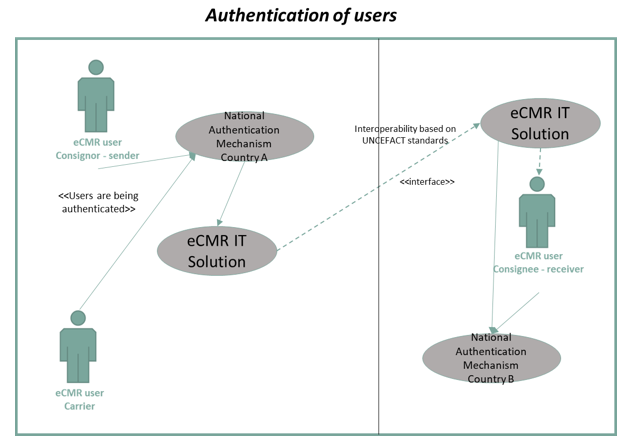
1. Authentication of users
|
Name |
Authentication of users by the National authentication mechanisms use case |
|
Description |
Each user should be authenticated and prove this authentication by using their national authentication mechanisms. The proof of authentication (unique code?) should be used in order to register at the IT solutions. |
|
Actors |
Consignor, Carrier, Consignee |
|
Goals |
Only authenticated users can access and use any eCMR IT solution (Proof of authentication might be required). |
|
Preconditions |
The user is an authenticated user. |
|
Postconditions |
The user is allowed to gain access to any eCMR IT solution. |
|
Scenario |
Authentication The IT solutions should be able to check if the information provided by the user is valid and registered in the national authentication mechanism. |
|
Alternative Scenario |
Fallback scenario If the authentication fails for any reason, the user will be informed accordingly. Then the user will be required to rectify the information provided for the authentication to be successful. Also, for future reference, the IT solution should be also informed in case a user is not any longer authenticated for several reasons. |
|
Special requirements |
Required user information for accessing any IT eCMR solution |
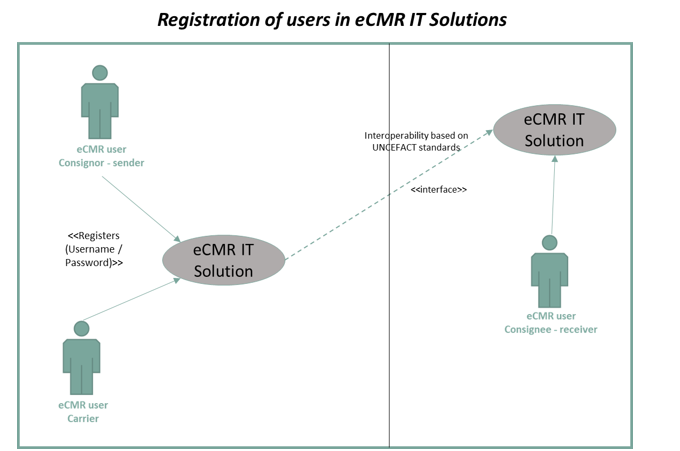
2. Registration of users in eCMR IT Solution
|
Name |
Registration of users in the IT solutions |
|
Description |
As an eCMR user, I want to be able to register myself (create an account) in an eCMR IT Solution so that I can use eCMR procedure. Each user should register themselves in the eCMR IT solutions of their choice in order to be able to submit, authenticate, and receive data. Upon submitting user information to register, the registering user will have to authenticate the user profile information data using the national authentication mechanism. |
|
Actors |
Consignor, Carrier, Consignee |
|
Goals |
Receiving an eCMR User ID and being able to use the eCMR procedure. |
|
Preconditions |
The user who registers in any IT solution should have been first authenticated by its national authentication mechanism and this unique authentication id should be provided for the registration |
|
Postconditions |
The user account is created in the eCMR IT solution, and this one is issued an eCMR User ID. |
|
Scenario |
Registration The system registers the users and notifies them with results of the registration and of their eCMR User ID. |
|
Alternative Scenario |
Fallback scenario If the registration fails for any reason, the user will be informed accordingly. Then the user will be required to rectify the information provided for the registration to be successful. |
|
Special requirements |
The users will be able to update their information in the eCMR IT solution and keep all relevant to their work, files, statistics etc. |
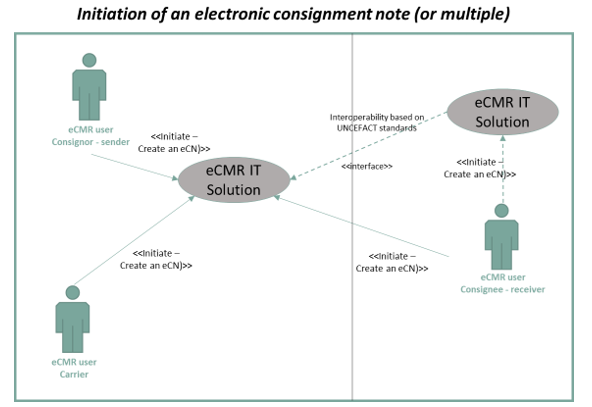
3. Initiation of an electronic consignment note (or multiple)
|
Name |
Initiation of the electronic consignment note use case |
|
Description |
As an eCMR user (consignor, carrier or consignee) I want to be able to initiate an electronic consignment note (or multiples for the same cargo) in the selected IT solution so that the different parties can agree on the eCN content (and eventually finalize it). The party initiating the electronic consignment note should know and use the eCMR User IDs of the other partners. In some cases, the consignee will be informed for a new electronic consignment note issued, if agreed by the carrier and consignor. |
|
Actors |
Consignor, Carrier, Consignee |
|
Goals |
Create a draft eCN record in the eCMR IT solution that can be consulted and edited by the other parties. |
|
Preconditions |
The holders of the contract of carriage registered in the eCMR IT solution. |
|
Postconditions |
The electronic consignment note initiated is recorded in the eCMR IT solution with the status “draft initiated” . A unique eCN ID is generated and associated to the eCN record for future reference. The consignor and the carrier can further edit it the eCN record (in order to finalize it eventually). |
|
Scenario |
Initiation A consignor initiate an eCN in his eCMR IT Solution setting the eCMR User ID of the Carrier and so that this one (already registered in the eCMR IT Solution) get notified and can access it. Optionally, if the Consignee is also registered and if the eCN initiator decide so, the Consignee can be notified and can also consult (read-only) the eCN record. |
|
Alternative Scenario |
Fallback scenario If the eCN cannot be sent to the IT solution by mean of any electronic means, no functional fallback is foreseen, and the same information can be sent as soon as it is possible by the party declaring the eCMR consignment note. If the problem persists then either another platform should be used or a paper consignment note will be prepared. |
|
Special requirements |
- |
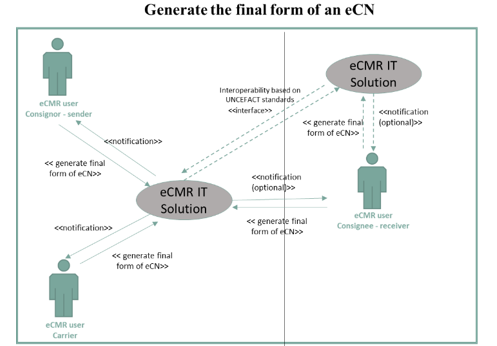
4. Generation of the final form of the electronic consignment note
|
Name |
Generation of the final form of the electronic consignment note use case |
|
Description |
As a consignor or Carrier, I want to be able to generate the final form of the electronic consignment note in the selected eCMR IT solution so that the other parties get notified that the eCN is ready to be authenticated. The party generating the final form of the electronic consignment note should be sure that the data is correct, it has been corrected / agreed by all other parties and that the final form should be generated. The other parties will be informed when the final form has been generated. |
|
Actors |
Consignor, Carrier, Consignee |
|
Goals |
Generation and recording of the final form of the electronic consignment note and notification of the interested parties |
|
Preconditions |
The electronic consignment note should have been initiated and the data completed, and the finalizing actor should be registered in the eCMR IT Solution. |
|
Postconditions |
The final form of the electronic consignment note generated is stored in the eCMR IT solution with the status “finalized” ready for the consignor and the consignee to authenticate it. |
|
Scenario |
Initiation Once the electronic consignment note has been initiated and adjusted by the different parties, either the consignor or the carrier – independently to who has initiated the electronic consignment note – should generate the final form of the electronic consignment note. The other party (consignor and consignee) is notified and can review the electronic consignment note for authentication. |
|
Alternative Scenario |
Fallback scenario If the final form of the eCMR consignment note cannot be generated the system should notify the users of the reasons and direct them on how to fix them. If it is a technical problem, then users should be able to electronically address this problem to the administration of the IT solution seeking for an immediate solution. |
|
Special requirements |
- |
5. Successive Carriers
|
Name |
Successive Carriers |
|
Description |
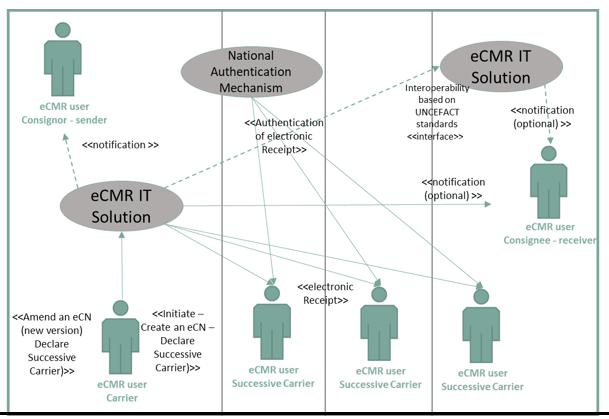
The carrier should be able to add in the electronic consignment note its successive carriers. The carrier should be able to do this at any point. The carrier should be able to add as many successive carriers as requires. Also, the carrier should be able to define which part of the journey will be covered by which successive carrier. For reasons of liability the successive carriers should through the system be able to confirm that they are responsible for the specific parts of the journey and provide comments, reservations and amendments to the data of the electronic consignment note accordingly. A carrier accepting the goods from a previous carrier shall give the latter a dated and signed receipt. Where applicable, the carrier should be able to enter on the receipt reservations of the kind provided for in article 8 paragraph 2 of the convention. The eCMR system should be able to accommodate this provision by providing electronic receipts. This electronic receipt should be authenticated by both carriers following the authentication methods described for the electronic consignment note. |
|
Actors |
Carrier, Successive Carriers, Consignor, Consignee |
|
Goals |
Carrier should be able to declare successive Carriers. |
|
Preconditions |
Successive Carriers are also authenticated. |
|
Postconditions |
Transportation has been performed by several carriers based on clear procedures that could justify limitation of their liability. |
|
Scenario |
Authentication The Carrier should be able to declare successive Carriers following the same conditions /services that apply for the Carrier. |
|
Alternative Scenario |
Fallback scenario - |
|
Special requirements |
- |
6. Subcontracting Carriers
|
Name |
Subcontracting Carriers |
|
Description |
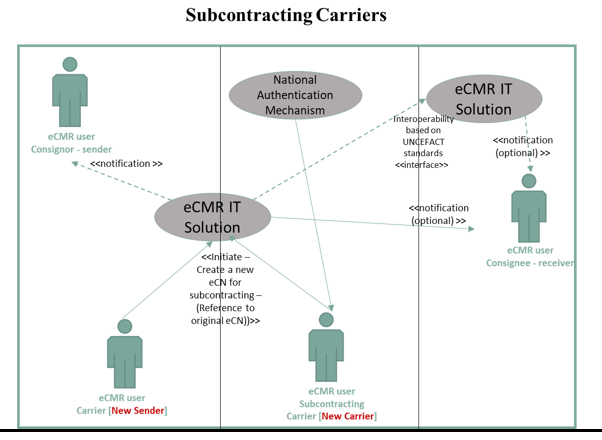
Sub-contracted carriers are not parties to the same contract of carriage. There are consequently several contracts: a contract of carriage between the principal and the contracted carrier and a contract of subcarriage between the contracted carrier and the sub-contracted carrier. A new consignment note must be drawn up for each sub-contracted carrier, where the subcontracting carrier is entered as the sender. The sub-contracted carrier is liable only to the initial carrier, whilst the latter is liable to the sender and the consignee for acts and omissions on the part of other parties, he may use for the transport operation. |
|
Actors |
Carrier, Subcontracting Carriers, Consignor, Consignee |
|
Goals |
Carrier should be able to declare Subcontracting Carriers. |
|
Preconditions |
Subcontracting Carriers are also authenticated. |
|
Postconditions |
Transportation has been performed by several carriers based on clear procedures that could justify limitation of their liability. |
|
Scenario |
Authentication The Carrier should be able to declare Subcontracting Carriers following the same conditions /services that apply for the Carrier. |
|
Alternative Scenario |
Fallback scenario - |
|
Special requirements |
- |
7. Authentication of the final form of an eCN
|
Name |
Authentication of the final form of the electronic consignment note |
|
Description |
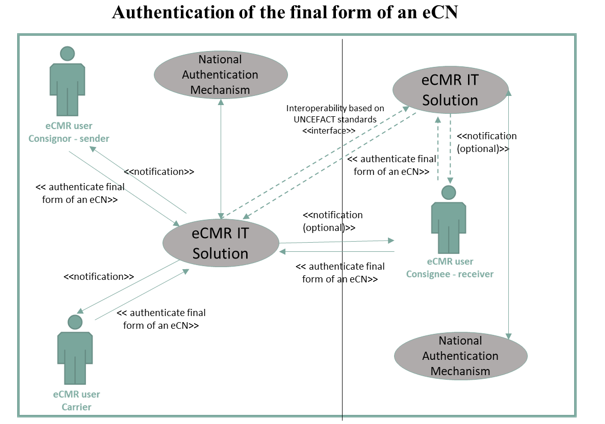
As an eCMR user (Consignor, Carrier, Consignee) I want to use my country national authentication mechanism to authenticate eCN data in the eCMR IT Solution I’m using so that the information I provide is trustworthy, not tampered with and verifiable. The proof of authentication (digital signature, MAC, HMAC, Certificate, …) should be attached to the authenticated data (eCN record, eCN update, provision, …) in eCMR IT solutions. |
|
Actors |
Consignor, Carrier, Consignee |
|
Goals |
Only authenticated users can access and use any IT solution (Proof of authentication might be required). |
|
Preconditions |
The user is an authorized / authenticated user. |
|
Postconditions |
The user is allowed to gain access to any IT solution. |
|
Scenario |
Authentication The eCMR user should be able to submit trustworthy, untampered and verifiable information in the eCMR IT solution provided by the user is valid and registered in the national authentication mechanism. |
|
Alternative Scenario |
Fallback scenario If the authentication fails for any reason, the user will be informed accordingly. Then the user will be required to rectify the information provided for the authentication to be successful. Also, for future reference, the IT solution should be also informed in case a user is not any longer authenticated for several reasons. |
|
Special requirements |
Required user information for accessing any IT eCMR solution |
8. Amend final form of an eCN
|
Name |
Amend final form of an eCN |
|
Description |
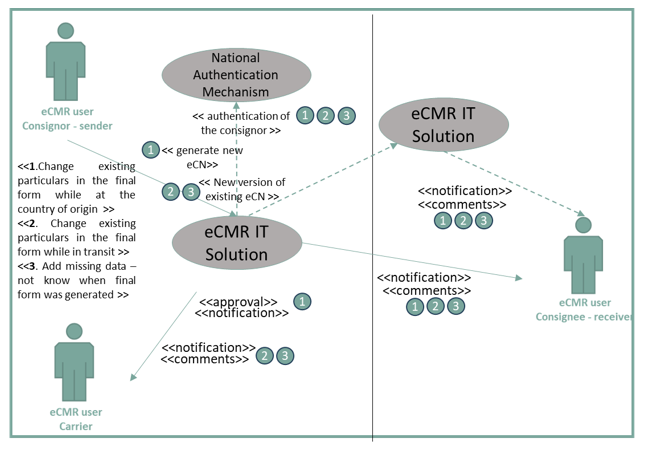
The eCMR users should be able to amend the final form of an eCN in case it is required. However, this has to be done following a specific procedure ensuring integrity of the data. Three scenarios have been identified when the final form of an ECN might need to be amended: 1. While the truck still at the country of origin (for instance at the customs premises) and there is a need to correct the data. Then a new eCN will be generated. 2/3 when changes has to be provided in data (existing or missing) other than the disposal of the goods. Then, the versioning of the eCNs will be used to address those changes. |
|
Actors |
Consignor, Carrier, Consignee, |
|
Goals |
Ensure that the eCN includes correct / updated data – Ensure integrity of data. |
|
Preconditions |
Whoever of the users provides the changes, authenticate themselves and the other users must approve / agree with the changes or provide comments if needed. |
|
Postconditions |
The Carrier (and Consignee) is always informed with the most updated data. |
|
Scenario |
Initiation The system provides the option to amend the data of the eCN ensuring integrity of data and that users agreed with the new amendments. |
|
Alternative Scenario |
Fallback scenario Other electronic methods should be used in case there is no access to the systems to provide those changes. Users do have an electronic copy of the eCN generated by the system. |
|
Special requirements |
- |
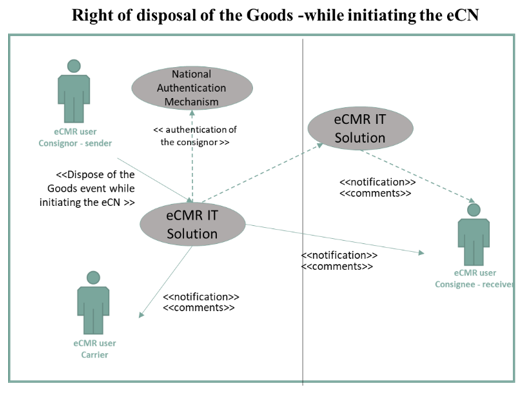
9. Right of disposal of the Goods -while initiating the eCN
|
Name |
Right of disposal of the Goods -while initiating the eCN of the goods use case |
|
Description |
The consignor has the right to dispose of the goods while initiating the electronic consignment note. In such a case the carrier and the consignee should be informed, and the disposal of the goods process should be always initiated with an authentication of the consignor. |
|
Actors |
Consignor, Carrier, Consignee, |
|
Goals |
Ensure that the carrier knows at any time who has the right to dispose of the goods and from whom has to take orders. |
|
Preconditions |
The right of disposal of the goods belongs to the consignor and the consignor is the only one that can initiate this process. |
|
Postconditions |
The Consignee will have the right to dispose the goods and declare a new consignee if required |
|
Scenario |
Initiation The consignor should decide when he/she wants to transfer the right of dispose of the goods to the consignee. The system provides the option the procedure to be initiated at any stage of the journey. |
|
Alternative Scenario |
Fallback scenario If the disposal of the goods remains with the consignor, then the Convention foresees different ways for the consignee and the carrier to react and request instructions from the consignor. |
|
Special requirements |
- |
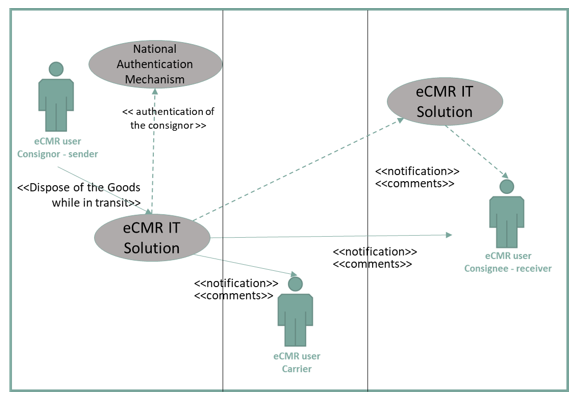
10. Dispose of the goods – while in transit
|
Name |
Dispose of the goods – while in transit |
|
Description |
The consignor has the right to dispose of the goods while the cargo is in transit. In such a case the carrier and the consignee should be informed, and the disposal of the goods process should be always initiated with an authentication of the consignor. |
|
Actors |
Consignor, Carrier, Consignee, |
|
Goals |
Ensure that the carrier knows at any time who has the right to dispose of the goods and from whom has to take orders. |
|
Preconditions |
The right of disposal of the goods belongs to the consignor and the consignor is the only one that can initiate this process. |
|
Postconditions |
The Consignee will have the right to dispose the goods and declare a new consignee if required |
|
Scenario |
Initiation The consignor should decide when he/she wants to transfer the right of dispose of the goods to the consignee. The system provides the option the procedure to be initiated at any stage of the journey. |
|
Alternative Scenario |
Fallback scenario If the disposal of the goods remains with the consignor, then the Convention foresees different ways for the consignee and the carrier to react and request instructions from the consignor. |
|
Special requirements |
- |
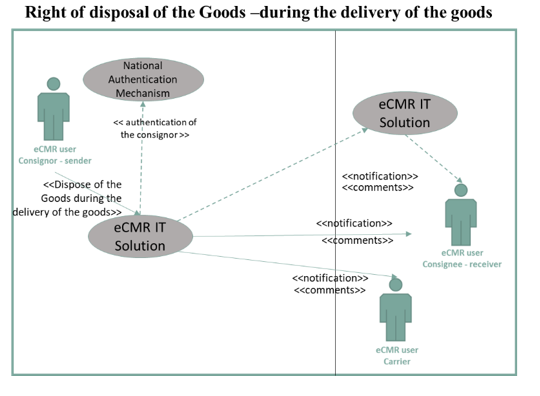
11. Dispose of the goods – during the delivery of the goods
|
Name |
Dispose of the goods – during the delivery of the goods |
|
Description |
The consignor has the right to dispose of the goods while the cargo is being delivered to the consignee. The Carrier and the Consignee should be informed. The disposal of the goods process should be always initiated with an authentication of the consignor. |
|
Actors |
Consignor, Carrier, Consignee, |
|
Goals |
Ensure that the carrier knows at any time who has the right to dispose of the goods and from whom has to take orders. |
|
Preconditions |
The right of disposal of the goods belongs to the consignor and the consignor is the only one that can initiate this process. |
|
Postconditions |
The Consignee will have the right to dispose the goods and declare a new consignee if required |
|
Scenario |
Initiation The consignor should decide when he/she wants to transfer the right of dispose of the goods to the consignee. The system provides the option the procedure to be initiated at any stage of the journey. |
|
Alternative Scenario |
Fallback scenario If the disposal of the goods remains with the consignor, then the Convention foresees different ways for the consignee and the carrier to react and request instructions from the consignor. |
|
Special requirements |
- |
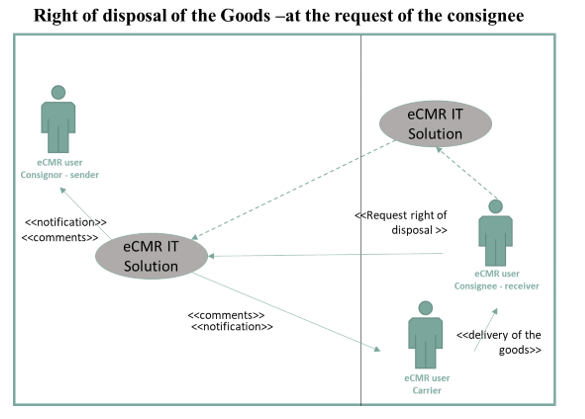
12. Dispose of the goods – at the request of the consignee
|
Name |
Dispose of the goods – at the request of the consignee |
|
Description |
The consignee has the right to request the transfer of the right to dispose of the goods – if the Consignor has not done it already - while the cargo is being delivered by the Carrier. The Carrier and the Consignor will be informed. |
|
Actors |
Consignor, Carrier, Consignee, |
|
Goals |
Ensure that the carrier knows at any time who has the right to dispose of the goods and from whom has to take orders. |
|
Preconditions |
The right of disposal of the goods belongs to the consignor and the consignor is the only one that can initiate this process. |
|
Postconditions |
The Consignee will have the right to dispose the goods and declare a new consignee if required |
|
Scenario |
Initiation The consignor should decide when he/she wants to transfer the right of dispose of the goods to the consignee. The system provides the option the procedure to be initiated at any stage of the journey. |
|
Alternative Scenario |
Fallback scenario If the disposal of the goods remains with the consignor, then the Convention foresees different ways for the consignee and the carrier to react and request instructions from the consignor. |
|
Special requirements |
- |
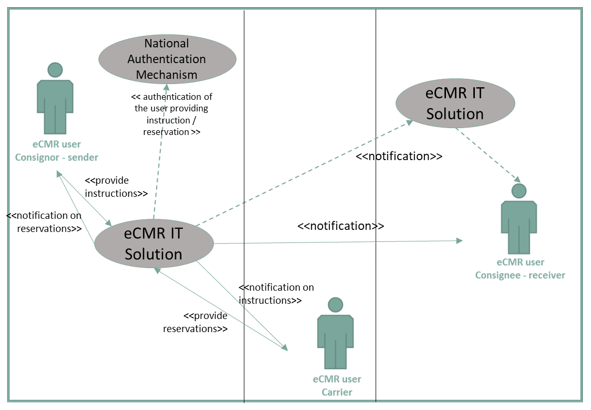
13. Provide instructions – reservations
|
Name |
Instructions – Reservations |
|
Description |
The CMR Convention foresees the provision of reservations – instructions by the users at certain points of the trip. Those reservations / instructions are legally binding information connected with the limitation or not of the liability of the carrier and they should be treated separately from the generic comments. In some cases, users should authenticate themselves while providing those instructions / reservations or when they do accept / do not accept them providing alternative comments. |
|
Actors |
Consignor, Carrier, Consignee, |
|
Goals |
Ensure that the carriers can limit their liability at any point by receiving clear instructions and by providing reservations. |
|
Preconditions |
The users responsible for providing instructions or reservations should be able to do so ensuring the integrity of data. |
|
Postconditions |
The Carrier will have clear instructions and be able to provide reservations whenever required. |
|
Scenario |
Initiation The consignors should decide when they want to provide instructions to the Carriers and the Carriers they should decide when they should provide reservations ensuring always proper registering in the system of those instructions / reservations and their integrity. |
|
Alternative Scenario |
Fallback scenario . |
|
Special requirements |
- |
14. Delivery of the Goods
|
Name |
Delivery of the Goods |
|
Description |
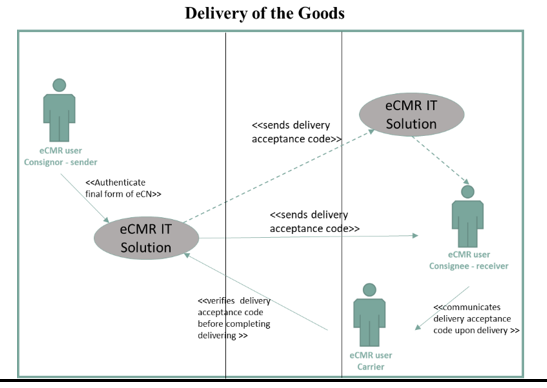
As a Consignee I want to be able to receive a CMR transport so that the delivery is completed securely. At the time the consignment note is concluded online, the consignees should be communicated (via mobile phone and/or email address) a secret delivery acceptance code. This code will be asked by the carrier upon the delivery of goods to the consignee to be verified by the eCMR IT Solution in order to authorize the Carrier to complete the delivery of the goods. At same the time the consignee gets transferred the right of disposal of the goods, thereby replacing the receipt of the second copy of the consignment note. This action would trigger notifications to the relevant users that the goods have been delivered. |
|
Actors |
Carrier [Subcontractors, Successive Carriers] , Consignee, |
|
Goals |
Ensure that the carrier delivers the good to the right consignee. |
|
Preconditions |
The consignee should have been declared while initiating the electronic consignment note with correct contact information and should have been sent the delivery acceptance code. |
|
Postconditions |
The consignee gets the right of disposal of the goods. The Consignee should be able to perform the proof of acceptance of the goods process/user case. |
|
Scenario |
Initiation The truck arrives at the premises of the consignee and the drivers requests the unique code to be inserted in the eCMR IT Solution in order to verify the consignee identity and confirm the proof of delivery process. |
|
Alternative Scenario |
Fallback scenario If the consignee does not have the unique code then the administration of the IT solution should be addressed in case of system failure. The consignor should be able – since this is connected with the disposal of the goods therefore not the carrier- to check in the system again the contact details of the consignee, correct them if wrong and trigger a “send unique code to consignee event” in order for the system to send another unique code to consignee. |
|
Special requirements |
- |
15. Acceptance of the Goods
|
Name |
Acceptance of the Goods |
|
Description |
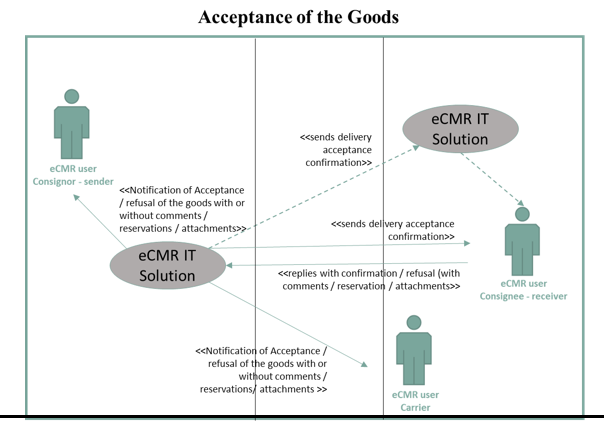
As a Consignee I want to be able to accept delivery of a CMR transport so that the Consignor is confirmed of delivery secure completion. The consignee has the right to check the goods and accept or refuse them or not or even to declare a new consignee. Therefore, the consignee should enter in the system and either accept the delivery online finalizing the consignment note or making reservations / remarks / comments (also uploading photos / videos that justify those reservations. The carrier in that moment will have the opportunity to read those comments without being able to delete them but be able to provide replies if needed. |
|
Actors |
Carrier, Consignee, |
|
Goals |
Ensure that the goods are accepted by the consignee, and if refused that reservations are recorded and communicated to the Carrier and Consignor. |
|
Preconditions |
The consignee should have first accepted delivery of the goods. |
|
Postconditions |
Depending on the action of the consignee (no acceptance, acceptance, acceptance with reservations, new consignee) the carrier and the consignor should act accordingly. |
|
Scenario |
Initiation The consignee checks the goods, the condition, packaging etc. |
|
Alternative Scenario |
Fallback scenario Depending which scenario will be selected then the Convention applies. |
|
Special requirements |
- |
16. Consignee declares new Consignee
|
Name |
Consignee declares new Consignee |
|
Description |
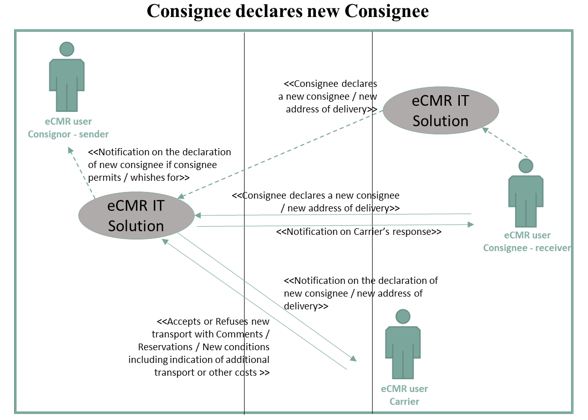
As a Consignee I should be able to declare a new consignee / delivery address to the carrier after acceptance of delivery of the goods. The consignee should enter in the system the new delivery address and the new consignee. The carrier in that moment will have the opportunity to read these new instructions and accept or refuse with reservations / comments including additional requirements (costs etc). |
|
Actors |
Carrier, Consignee, |
|
Goals |
Ensure that the goods are delivered to their final destination / consignee and Carrier is properly informed and accepted – or refused – this new assignment. |
|
Preconditions |
The consignee should have first accepted delivery of the goods. |
|
Postconditions |
The carrier should accept this new assignment. |
|
Scenario |
Initiation The consignee accepts the goods and declares new delivering point etc. |
|
Alternative Scenario |
Fallback scenario Depending which scenario will be selected then the Convention applies. |
|
Special requirements |
- |
17. Fallback procedure
|
Name |
Fallback procedure use case |
|
Description |
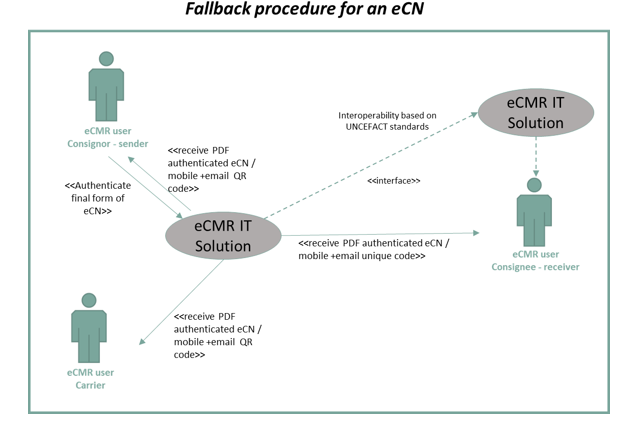
The fallback procedure is of paramount importance for the operations of the future eCMR system when for some reasons the system(s) does not work as designed. |
|
Actors |
Consignor, Carrier, Consignee, IT Solution |
|
Performance Goals |
Ensure that the market will continue to operate by using the CMR Convention and independently if the consignment note is electronic or not. |
|
Preconditions |
The fallback procedures are well defined and accepted by all actors. Paper consignment notes can be still used and accepted when the conditions are imposing to. |
|
Postconditions |
All solutions described are accepted as equivalent to a paper consignment note |
|
Scenario |
Initiation When the processes for initiating an eCN / generating a final form of eCN / authenticating the final form of eCN do not function or generate errors or there is no access to internet. Also, when en route there are for instance electricity cuts / no access to internet and authorities cannot check online the consignment note. |
|
Alternative Scenario |
Fallback scenario Paper consignment note could be used anytime is required or imposed to. The system should provide online assistance is required but also will generate PDF files / QR codes / that include all data of eCN to be disseminated to different users in cases of implementation of fallback procedures agreed. |
|
Special requirements |
- |
|
Name |
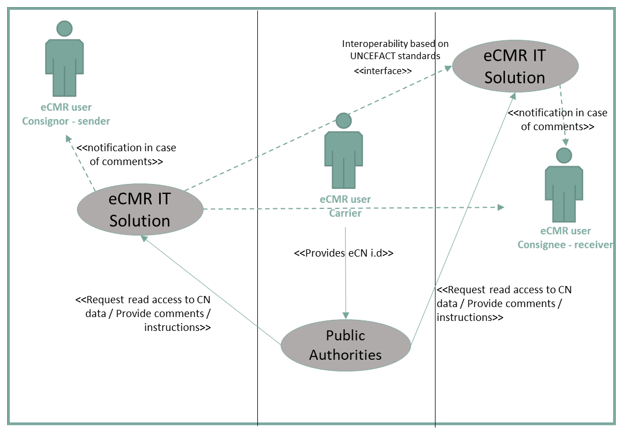
Public Authorities read access – provision of comments / instructions |
|
Description |
Public authorities following national laws requirements check the CMR Consignment notes. Also, in several instances including and most importantly in violation of law cases, Public Authorities should keep copies of the data and should be able to provide comments or instructions. |
|
Actors |
Consignor, Carrier, Consignee, IT Solution, Public Authorities |
|
Goals |
International transport under the digital procedures of the CMR convention is warranted. |
|
Preconditions |
Customs Authorities should be able to have read access to the original data and the IT Solution should provide space for them to provide comments and reservations if needed. |
|
Postconditions |
Comments / Reservations by public authorities cannot be deleted and should be readable by any stakeholders including public authorities of other countries. |
|
Scenario |
Initiation Trucks under CMR Convention perform international transport that requires border crossings. |
|
Alternative Scenario |
Fallback scenario In case that systems are not operational, or connections lost public authorities should be able / agree to accept the paper eCN generated by the system (fall back procedure). |
|
Special requirements |
- |